
1. Super specialty hospital chain
yatharthhospitals.com | NSE: YATHARTH
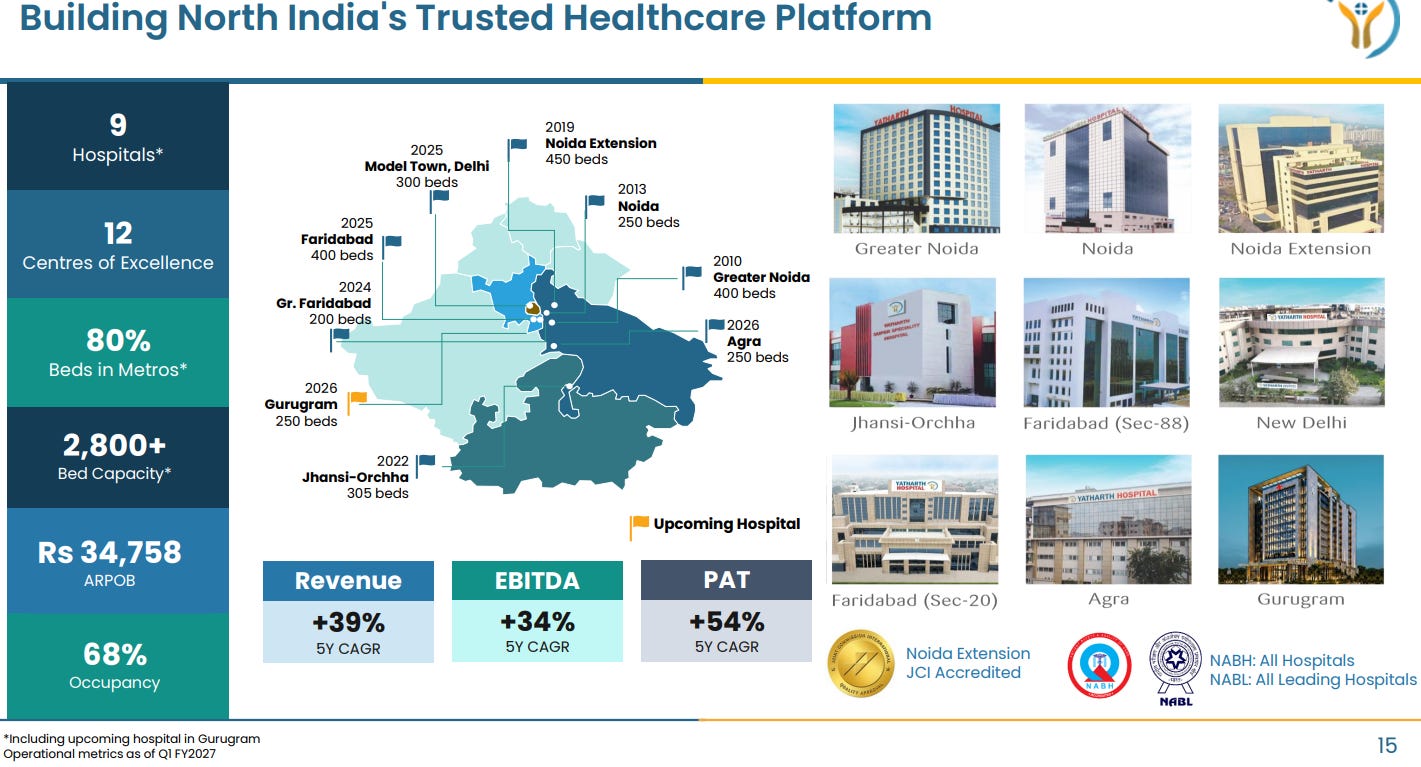
2. FY22–26: PAT CAGR 40% & Revenue CAGR 32%
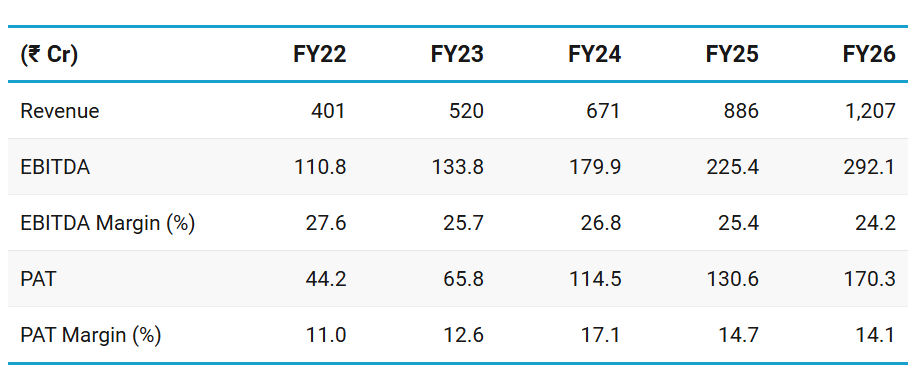
3. FY26: PAT up 30% & Revenue up 36% YoY

4. Q1 FY27: PAT up 8% & Revenue up 52% YoY
PAT up 2% & Revenue up 15% QoQ
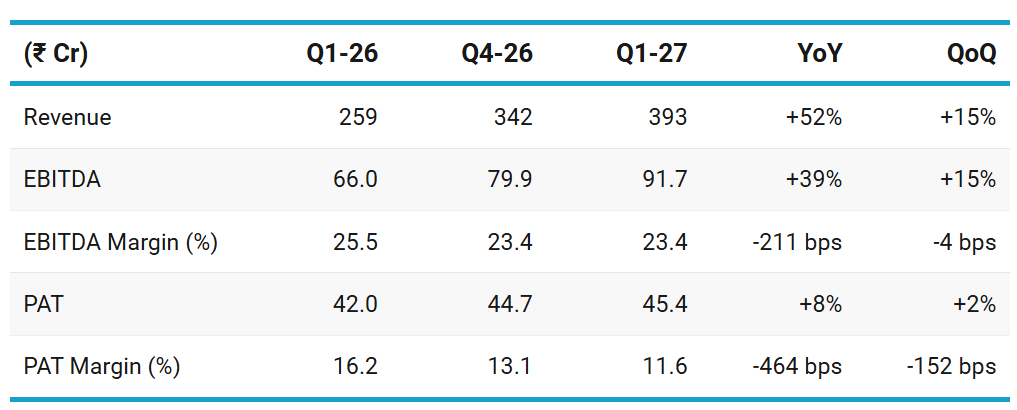
EBITDA Margin: Compression of 2% YoY — initial gestation of newly operational units.
Adjusting for ramp-up losses at the Model Town and Faridabad Sector 20 hospitals — adjusted EBITDA margin at a healthy 28.1% .
PAT Margin Compression:
Depreciation and amortisation costs up 89.3% YoY
Finance costs up 33x YoY
Aggressive capital expenditures and capacity additions over the last year.
5. Business Metrics: Weakening Ratios — Impacted by Expansions & Acquisitions
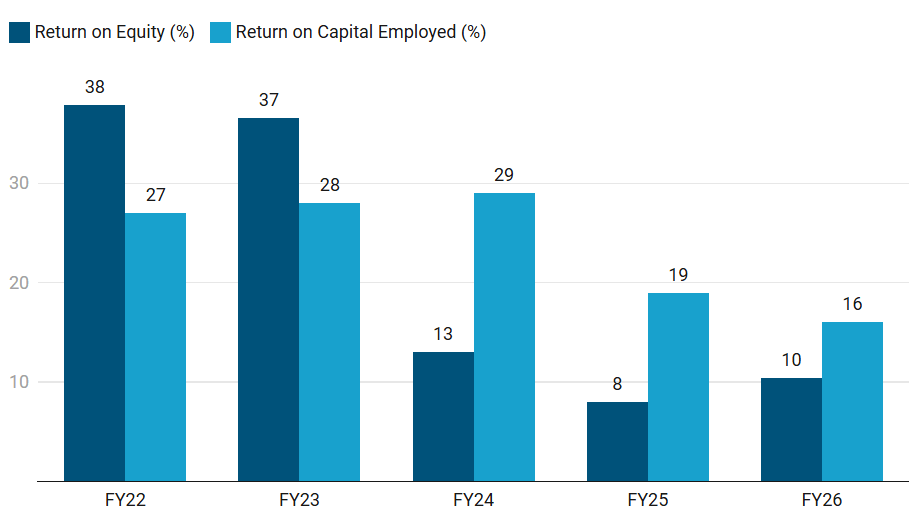
Yatharth is in a heavy expansion phase.
Fixed assets including goodwill increased, borrowings rose and the company has acquired/started multiple hospitals.
Denominator of ROE/ROCE has increased before the full profit contribution has come through.
That is not necessarily bad.
But it means FY27/FY28 must prove that the capital deployed can earn strong returns.
6. Outlook: 40% Revenue Growth; Stable Margin
6.1 Outlook for FY27 — Yatharth Hospital
FY27: I think we have said that last year, we grew 37% Y-o-Y. As you can clearly see this year, we will easily surpass that growth even the EBITDA is concerned. I think the company is on track close to upwards of 24% EBITDA margin for the full FY27 is concerned.
ARPOB: I think 9% to 10% is the right estimation to be taken.
FY28-FY29: I think what we said that this year will definitely be upwards of last year's revenue growth, and I think that also should be sustainable for the upcoming years ahead of that.
FY29 Margins: Within two years from today, I think new hospitals should be even upwards of 25% of EBITDA margin, somewhere around 27%, just like our existing mature units
6.2 Q1 FY27 Performance vs FY27 Guidance
Revenue, margins In-line, capacity expansion on schedule
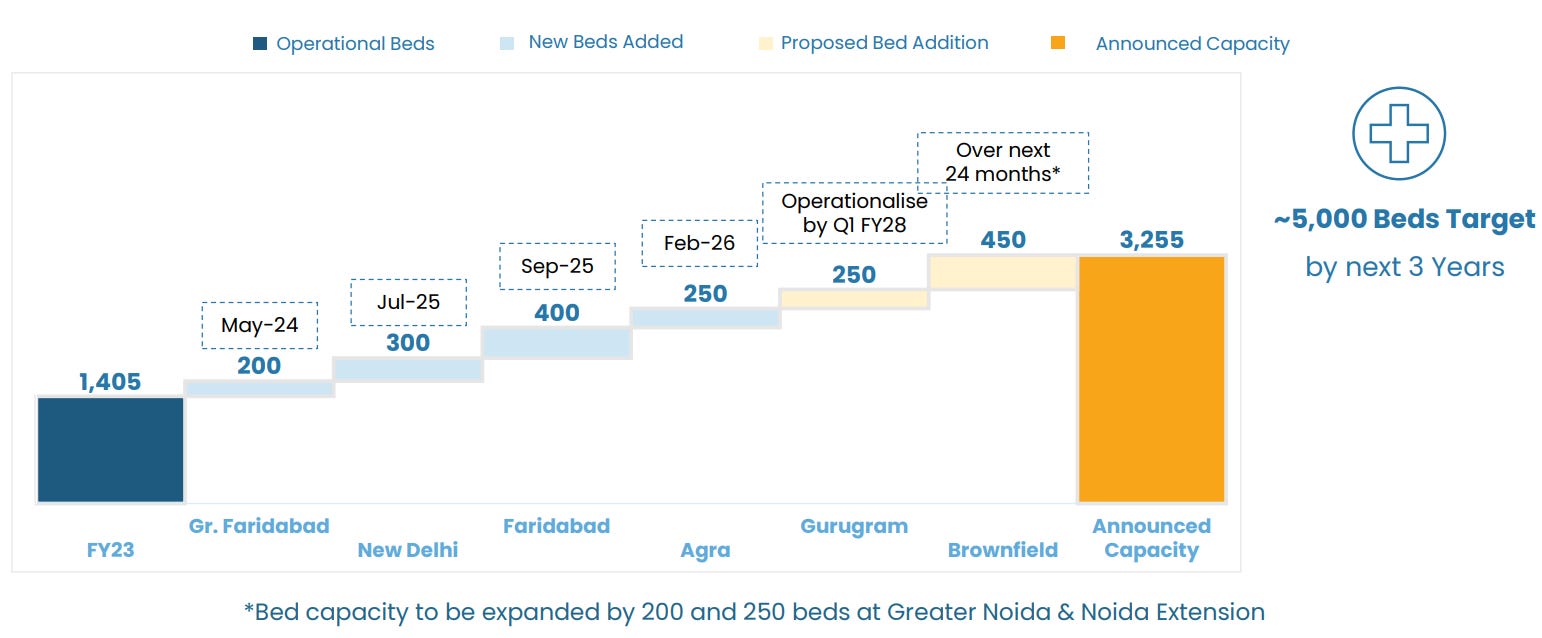
if you look at the 5,000-bed capacity, we feel that we would be even reaching it much earlier than the 3-year target announced.
Faridabad, we are glad that it has break even much before our target, but the way breakeven is also with less than 10% government business
As far as Delhi is concerned, we are sticking to our guidance. We expect that hospital to break even around 15 to 17 months. And it will 100%. It's on track as far as that is concerned
7. Valuation Analysis
7.1 Valuation Snapshot — Yatharth Hospital
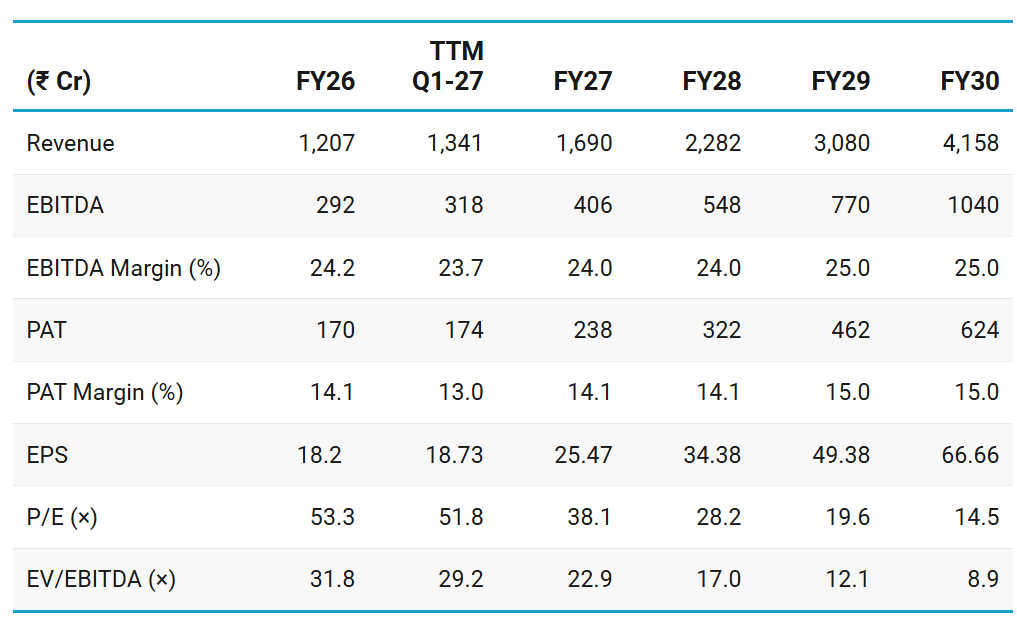
Current Market Price= ₹969.5; Market Cap = ₹9,296 Cr
Growth Assumptions — Conservative:
FY27 = 40%
FY28 onwards = 35%
Margin assumptions — As per management guiding of 24% moving to 25-27% range as newer hospital stabilize
Fully-priced from a FY27 perspective - no margin of safety if there are in hiccups along the way
Reasonably priced from a FY28 perspective — limited margin of safety
Opportunity emerges if FY29 is delivered with the newer hospitals stabilizing
7.2 Opportunity at Current Valuation
The opportunity is in FY28/FY30 if earnings catch-up if when 5,000-bed plan is executed on-time with efficiency.
Operating Leverage: As newer assets like Faridabad Sector 20 scale up from their current occupancy (49% in Q1 FY27) toward a mature 70% level, the incremental patients carry very high incremental EBITDA margins
Doubling of capacity to approximately 5,000 beds within 2.5-3 years is not yet discounted
Strong opportunity for those holding YATHARTH to keep riding the momentum as the plan of 5,000 beeds keeps getting executed
Management is targeting ~5,000 beds over the next 3 years, compared with current operational capacity of around 2,555 beds and announced capacity of ~3,255 beds could create a 2x+ opportunity in YATHARTH
2x beds +
improving APROB
improving occupancy
improving margins — as hospitals mature
improving payor mix with reduction of government schemes.
Self-Funded Expansion — Operating cash funds the next bed till the 5000 beds
Cash conversion rate (Operating Cash Flow to EBITDA) of 98% in FY26 (up from 70% in FY25).
Funding without Dilution:
Capital expenditure of ₹75-80 lakhs per bed for the upcoming 1,800 beds
Funded primarily via internal accruals and strong cash flows
No active plans for equity fundraising or dilution.
7.3 Risk at Current Valuation
Aster, Advent eye controlling stake in Yatharth Hospital, says report; shares rise 4.5%
However, Yatharth Hospital has denied that it is engaged in any sale discussions
There may be volatility based around the news flow in the near term.
Margin of safety is limited at current valuations.
Big risks for those entering YATHARTH at current levels
Delays in expansion could lead to a negative reaction in the stock price
The new hospitals are promising, but not fully mature. Delay in break-even can hurt reported margins and market confidence.
EBITDA Margin Headwinds
Newer hospitals integrated at lower initial margin
Faridabad Sector 20 only delivers a 4-5% EBITDA margin
Model Town is still operating at gestational losses.
As older assets mature and scale up, new acquisitions will continuously be added
Structurally consolidated group margin 24-25% range.
PAT Compression from Depreciation & Debt Costs
To fund inorganic additions and oncology equipment, the company’s non-cash and financial liabilities have spiked.
Projected to stay high at INR 29 crores per quarter.
To fund acquisition, debt on the books have risen creating a structural drag on cash earnings.
Yatharth’s overall government payer mix is still high — 40% in Q1 FY27.
Ayushman scheme carries much lower margins
Oncology Price Capping:
Oncology currently contributes 10% of revenue.
Pricing caps implemented on certain oncology drugs have already exerted a 20-30% negative pricing impact on those capped treatments within that segment.
Room Rent Cap Proposals — potential regulatory overhangs.
Government/panel recommendations proposing to limit private hospital room charges to 3-star hotel rates.
Implementation of standardized pricing grids remains a systemic risk.
70% of future beds may come through acquisitions. This leads to
Integration risk — acquired hospitals may not ramp as planned.
Capital allocation risk — paying too much for assets can depress ROCE.
Goodwill risk — goodwill has already increased meaningfully after acquisitions.
At high valuation, the market is assuming acquisitions will be disciplined and profitable.
Recent Coverage of YATHARTH

Don’t like what you are reading? Will do better. Let us know at hi@moneymuscle.in
Don’t miss reading our Disclaimer