
Confused about AUM, ROA and ROE in NBFC’s? Gain clarity now.

1. NBFC — Supply Chain Financing
sgfinserve.com | NSE: SGFIN
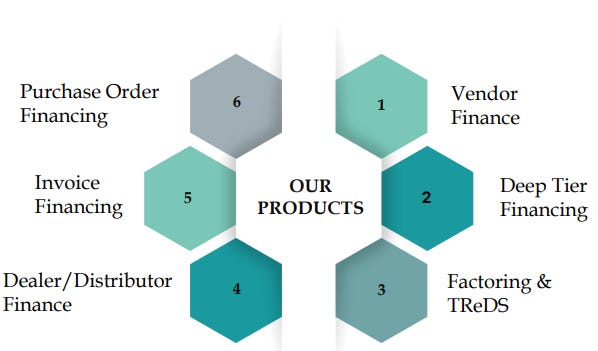
Business Mix & Portfolio
Part of APL Apollo Group (Group’s flagship co., APL Apollo Tubes Limited is India’s largest structured steel manufacturer)
Supply Chain Financing continues to be the core of our franchise, further strengthened by the commercialization of the Factoring & TReDS business
Became one of < 1% of NBFCs offering Factoring & TReDS solutions
2. FY23-26: PAT CAGR 91% & Net Inerest Income CAGR 81%
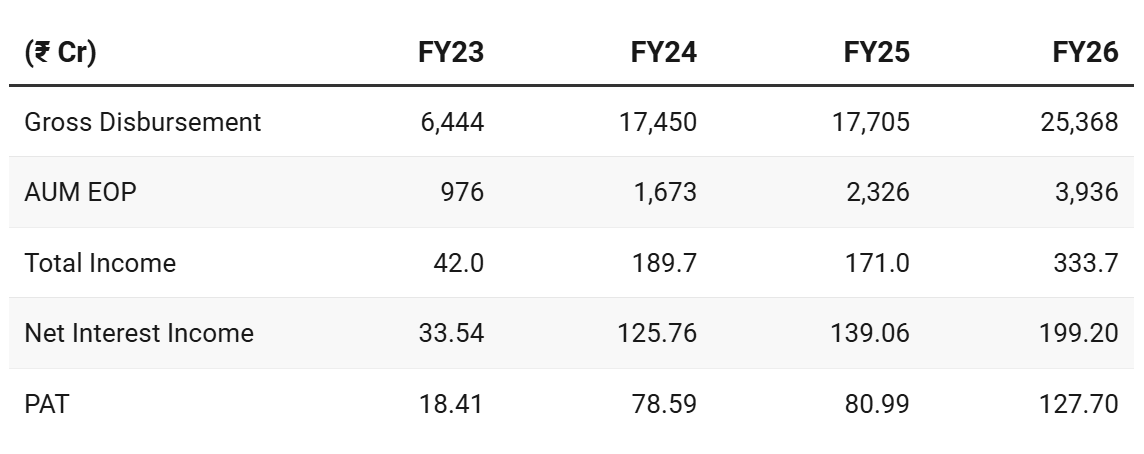
FY25: A regulatory pause lending in H1 to comply with Type II NBFC licensing norms muted growth
FY26: Leadership transition (H2) + downward revision in guidance (after Q2 results)
3. FY26: PAT up 58% & Net Interest Income up 44% YoY
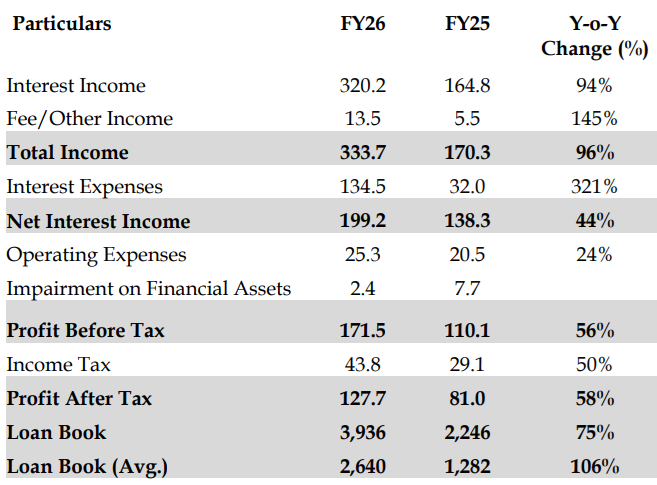
4. Q1FY27: PAT up 119% & Net Interest Income up 92%
PAT up 27% & Net Interest Income up 31% QoQ
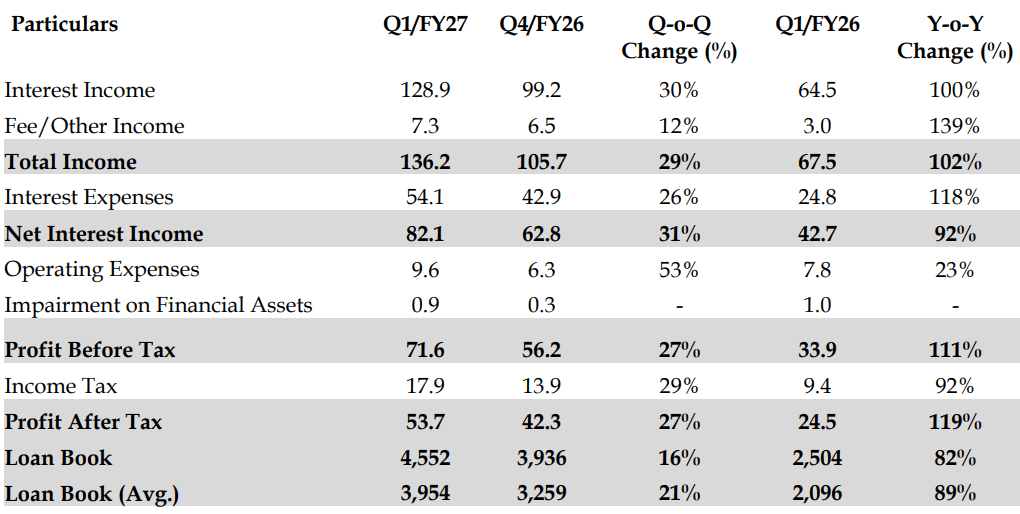
Q1 FY27 was SG Finserve’s strongest quarter so far. :
Should not extrapolate the 27% sequential profit growth.
Q1 benefited from the rapid deployment of equity raised around March–April.
The objective was to build the loan book early so that the larger earning base contributes throughout FY27.
Management itself expects future sequential growth to normalise toward a more sustainable level.
After normalising for this capital injection, underlying sequential growth may have been closer to 14–15% rather than 27%.
8–10% QoQ profitability growth would be a sustainable target going forward.
5. Business Metrics: Strong Return Ratios
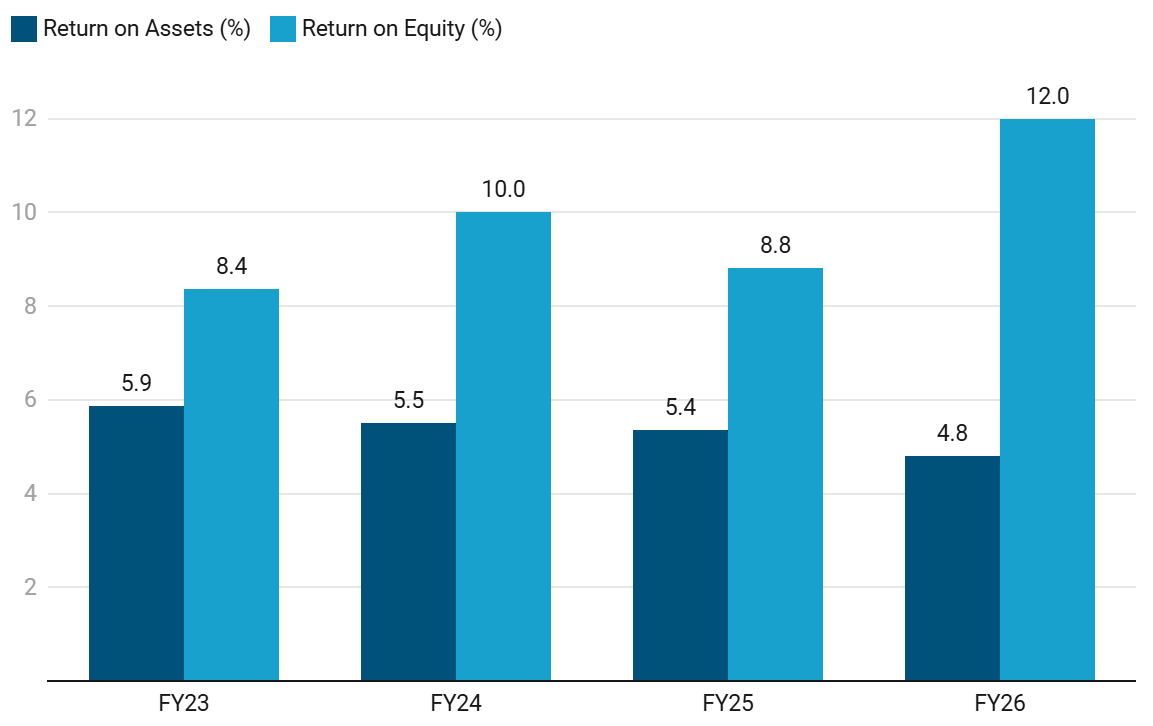
Management guidance:
ROA: 4.5–5% (sustainable)
ROE: 14–16% target
6. Outlook: 30-35% PAT CAGR
6.1 Management Guidance and Future Outlook
Over a period of three to four years, we plan to grow our AUM around 25% to 30% growth. However, profitability we are targeting to grow at 30% to 35% CAGR.
GROWTH, RETURNS & ASSET QUALITY
AUM: 25 - 30% CAGR
PAT: 30 - 35% CAGR
RoA: 4.5% - 5.0%
RoE: 14% - 16%
Cost/Income: 13% - 17%
NPAs: NIL
FY27 PAT & Equity: INR300 crores PBT translates to around INR225 crores kind of a PAT. So, it roughly reaches around INR1,700 crores kind of equity base as FY27 closing.
FY30 AUM: we are targeting to reach INR10,000 crores.
FY27 Management Guidance
FY27 closing AUM / Loan Book ~₹5,500 Cr
PBT ~₹300 Cr
Implied PAT ~₹225 Cr
RoA 4.5–5.0%
RoE 14–16% trajectory
Cost-to-Income13–17%; management intends to stay below ~15%
Asset quality — Aspiration to maintain NIL NPA
Equity raise — None planned in FY27
Expected FY27 closing equity ~₹1,700 Cr
Leverage strategy — Gradually move from ~2.2x to ~3x
FY27 PBT Guidance Looks Conservative
Management indicated that ~₹280 Cr annualised PBT is almost a “no-brainer” at the current base
Characterised the ₹300 Cr guidance as carrying a conservative cushion — effectively “under-commit and over-deliver.”
AUM Outlook: ₹5,500 Cr FY27 → ₹10,000 Cr FY30
Management acknowledged that current growth velocity is faster than originally expected and said some earlier FY30 objectives could potentially be achieved by FY29.
No Equity Raise Expected Until Around ₹10,000 Cr AUM
“We don’t plan to raise any equity because we don’t need to raise any equity.”
Core Growth Strategy: “Deepening + Widening”
Deepening means:
financing more dealers within existing anchor ecosystems,
increasing wallet share,
adding products to existing corporates,
moving from channel finance into factoring/invoice finance.
Widening
new corporate anchors,
new MSME customers,
new geographies,
new products,
adjacent financial services.
APL Apollo Dependence Should Continue Falling
SG Finserve originally grew largely from the APL Apollo ecosystem.
Management now expects roughly:
~1/3 AUM: APL Apollo ecosystem
~1/3: non-APL Apollo working-capital / supply-chain finance
~1/3: businesses beyond traditional supply-chain finance
Factoring & TReDS — Emerging Second Growth Engine
Factoring has only recently been commercialised but is gaining traction.
Roughly 5% of current AUM
Management expects factoring to become much larger because:
very few banks/NBFCs currently offer it,
TReDS is gaining acceptance,
regulatory support has improved,
B2B sectors not suited to traditional dealer financing can use factoring.
This is potentially SG Finserve’s most important new growth vertical.
LAP + Digital Lending Are Next
Management specifically identified two potential lending products:
Management sees LAP as a natural cross-sell opportunity to existing MSME borrowers.
Its existing digital infrastructure and MSME customer base provide the platform to potentially launch digital business lending.
Insurance Broking — Likely From Q4 FY27 or Later
SG Finserve has incorporated SG Insurance Brokers.
It will be a fee-based B2B broking/cross-selling business targeted at the company’s existing ecosystem.
Possible products include:
trade credit insurance,
keyman insurance,
employee/group health,
other MSME/corporate insurance products.
6.2 Q1 FY27 Performance vs FY27 Guidance – SG Finserve
We are on track to maintain our return on asset ranging from 4.5% to 5%, and we have already seen in Q1 that we already achieved 5.1%.
We are on track to grow our return on equity. We have already expanded from 12% in FY26 to 14% in Q1. Our aspiration is to grow from 14% to 16% as we move forward. Our aspiration is to maintain top-notch credit quality.
What is ahead?
AUM growth: much faster than the 25–30% long-term framework
Profit growth: far ahead of 30–35% CAGR guidance
RoA: above upper end
Cost efficiency: substantially better than guidance
Asset quality: exactly on target
What is merely on track?
₹300 Cr FY27 PBT: Q1 run-rate supports it comfortably
₹225 Cr PAT: requires only modest growth from Q1
₹5,500 Cr AUM: only ~21% additional growth required from June levels
What still needs improvement?
RoE: 14% is only the lower end of the 14–16% target. The next leg depends on increasing leverage and deploying capital efficiently.
7. Valuation Analysis — SG Finserve
7.1 Valuation Snapshot
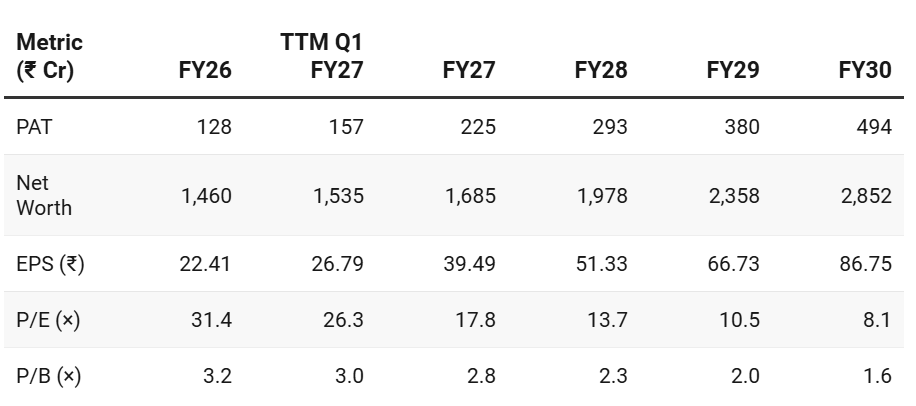
Current Price — ₹703.6
Market cap — ₹4,636.4 Cr
For a stock promising 25-30% long-term AUM CAGR and 30-35% PAT CAGR over the long-term with nil NPA the forward valuations of ~2.3× P/B (FY28) provide an opportunity for re-rating of multiples closer to 3× P/B
7.2 Opportunity at Current Valuation
Strong head-room to grow
Not cheap at current valuation — The opportunity comes from earnings compounding, not immediate undervaluation.
FY27 earnings appear reasonably de-risked. Management has said that the current run-rate gives it clear visibility toward the FY27 target.
The company does not require an exceptional acceleration from Q1 levels to meet FY27 guidance.
Earnings growth if delivered will compress the valuation. This creates an opportunity even without a significant rerating.
This shows both the opportunity and the limitation: earnings must continue growing, and the market must retain at least a reasonable premium multiple.
Growth may be funded without additional equity dilution
Management expects to grow to approximately ₹10,000 Cr AUM by FY30 without raising additional equity, supported by:
retained earnings,
current capital adequacy of around 32%,
leverage rising gradually from 2.2× toward 3×,
strong internal profitability.
RoE has room to improve
The opportunity is that SG Finserve is currently underleveraged relative to its target structure.
If the company can: maintain RoA near 5%, increase leverage toward 3×, keep credit costs negligible
RoE could move toward 16% without requiring higher lending yields or materially greater operating risk.
This would justify a higher P/B multiple than a conventional NBFC generating only 11–13% RoE.
New products provide optionality not fully included in forecasts
The current profit projections are predominantly based on lending.
Additional potential businesses include:
LAP cross-selling,
digital MSME lending,
B2B insurance broking,
international supply-chain finance through GIFT City,
longer-term AIF and other financial-services opportunities.
The formal strategy includes scaling supply-chain finance, deep-tier finance, factoring, invoice finance and TReDS, followed by LAP and digital lending.
Insurance broking could also add fee income without requiring lending capital, although management does not expect a meaningful launch before Q4 FY27 and regulatory approvals remain necessary.
At ₹703.60, the market is already paying for:
high growth,
5% RoA,
negligible credit costs,
successful execution of the ₹225 Cr FY27 PAT target.
The valuation becomes attractive around FY28–FY29 earnings, but only if execution remains strong.
The opportunity is not that SG Finserve is cheap today. The opportunity is that a high-quality lending franchise may grow earnings fast enough to make today’s valuation look cheap in two to three years.
7.3 Risk at Current Valuation
The biggest risk is not SG Finserve’s current balance sheet—it is the amount of future performance already embedded in the price.
Trade at premium multiples for an NBFC currently generating around 14% RoE.
Earnings disappointment can cause a double impact — lower earnings estimate + lower valuation multiple.
SGFIN already discounts strong FY27 execution
The current price is therefore not supported by present earnings alone.
It depends on the successful delivery of FY27 and FY28 growth.
Nil NPA may not be permanently sustainable
Management itself acknowledged that lending accidents and losses may eventually occur, even though the stated aspiration remains nil NPA.
Current valuation appears to price in:
negligible credit costs,
no major borrower failures,
continued recoverability,
stable supply-chain relationships.
Funding costs could compress spreads
Interest expenses grew faster than interest income during Q1.
This risk becomes more relevant as SG Finserve grows beyond its existing group ecosystem and increasingly competes for external borrowers.
Expansion into LAP and digital lending can change the risk profile
Supply-chain finance benefits from:
identifiable transaction flows,
anchor relationships,
shorter duration,
high repayment velocity.
LAP and digital MSME lending can behave differently
They can also dilute the low-credit-cost characteristics of the existing supply-chain franchise.
Investors should not automatically assign current nil-NPA record to new products before they are tested.
Adjacent businesses may distract management. SGFIN is simultaneously exploring:
insurance broking,
GIFT City,
AIF,
ARC,
LAP,
digital lending,
broader financial services.
Management’s 5–10-year vision is to become a comprehensive financial-services provider rather than only an NBFC. This creates optionality, but also the risk of:
management bandwidth dilution,
premature diversification,
regulatory complexity,
higher fixed expenses,
capital allocation mistakes,
entering businesses without an established competitive advantage.
The risks are higher that opportunity for new entrants in the stock
Existing holders can hold and ride the momentum.
Previous Coverage of SGFIN

Don’t like what you are reading? Will do better. Let us know at hi@moneymuscle.in
Don’t miss reading our Disclaimer