
1. Manufacturer of Power, Distribution & Specialty Transformers and Reactors
transformerindia.com | NSE: TARIL
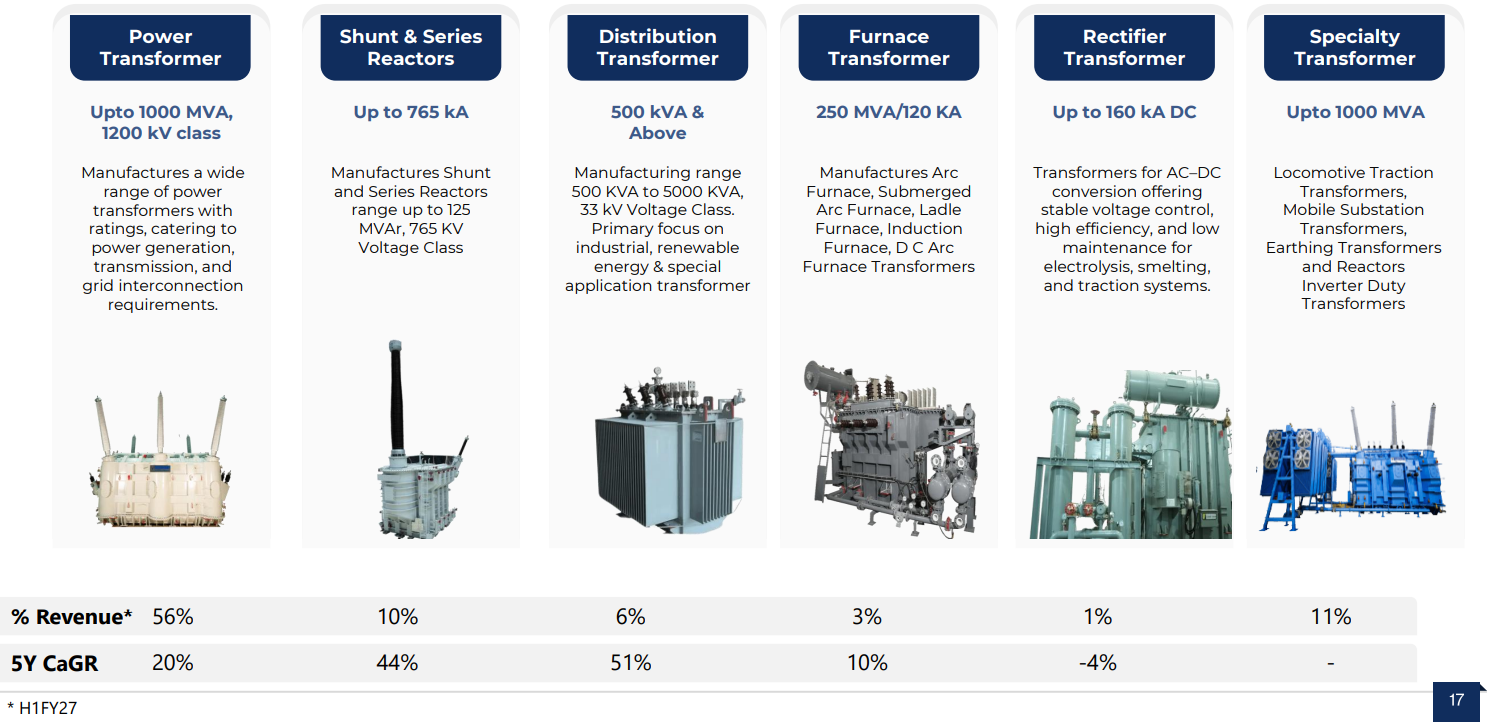
TARIL manufactures entire range of transformers viz.
Power
Distribution
Furnace
Specialty
Rectifier Transformers
Shunt Reactors
Solar Application Transformers
Earthing Transformers
Product capabilities across 5 kV-1,200 kV and 0.5 MVA-500 MVA
Serves Utilities, EPC players, Industrials, and Renewable Energy Sectors
Installed capacity of 75,000 MWA across 3 plants; supported by backward integrated manufacturing facilities in Gujarat
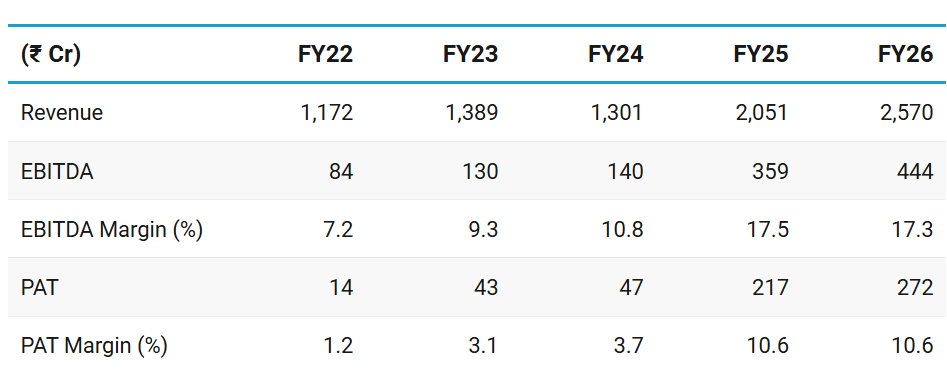
2. FY22–26: PAT CAGR of 109% & Revenue CAGR of 22%
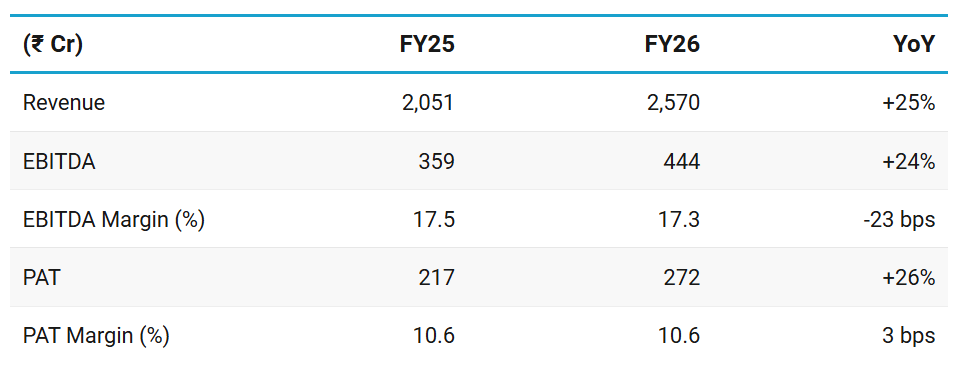
3. FY26: PAT up 26% & Revenue up 25% YoY
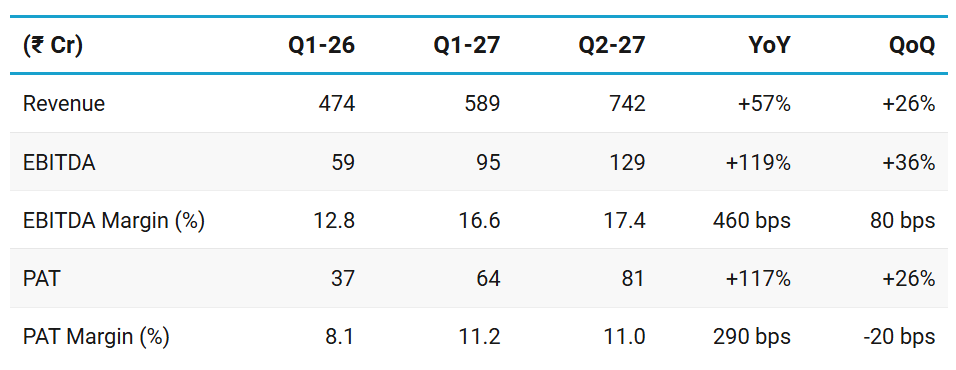
4. Q2-27: PAT up 117% & Revenue up 57% YoY
PAT up 26% & Revenue up 26% QoQ
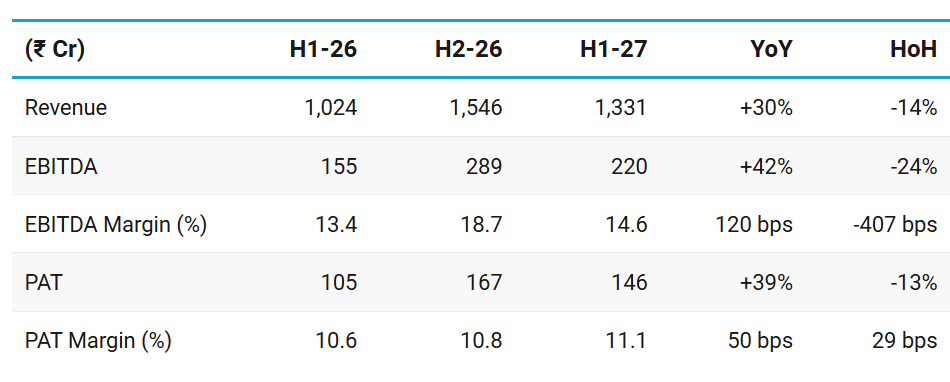
5. H1 FY27: PAT up 39% & Revenue up 30% YoY
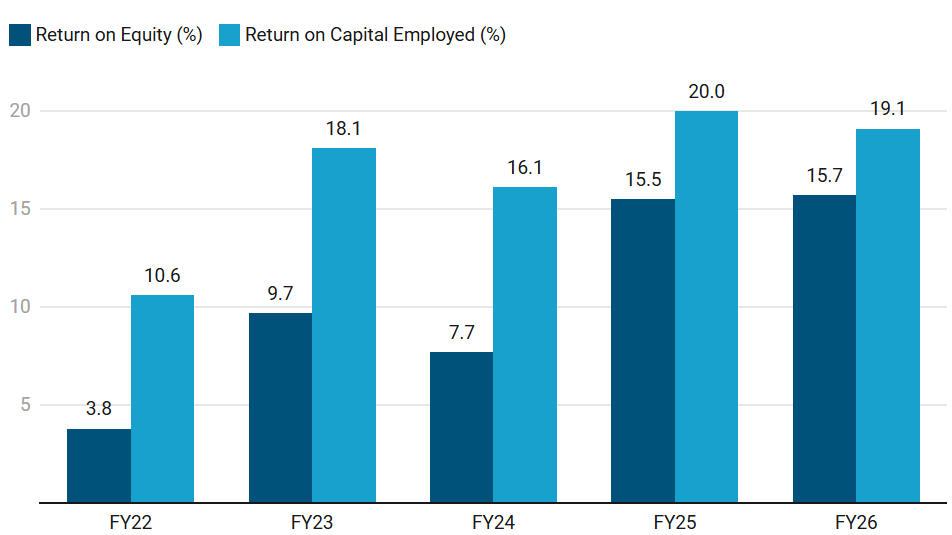
6. Business Metrics: Improving Return Ratios
7. Outlook: Revenue growth of 25%
7.1 Management Guidance
Our performance in Q2 reinforces our confidence in delivering our FY27 guidance, comprising 25% revenue growth, an EBITDA margin of 16%, and a PAT margin of 9% to 10%.
FY27 Revenue: Yes, I think we are maintaining our, you know, INR3,200 crores, so I think we are good at that
As of 30th September 2026, our unexecuted order book stood at 7,237 crore, up by 32% year-on-year, providing strong revenue visibility over the medium term. The order book is executable over the next 18 to 24 months.
We are pretty much sure that we'll reach USD1 billion. It will be late part of FY29 or early 2030.
So, we are looking at around 200 basis point to 300 basis point margin expansion through this backward integration.
But the full effect will seen by FY29
Guidance for 25% revenue growth for FY27, targeting revenue around ₹3,200 crore.
EBITDA margin of ~16% and a PAT margin of 9-10%.
Targeting USD 1 billion (~₹9,000+ crore) revenue by late FY29 or early FY30.
Beyond core power and distribution transformers, reaching this target relies on third-party commercial sales generated by its in-house backward integration units—including bushings, pressboard insulation, CRGO processing, CTC, and tank manufacturing (planned to be one of the largest units in Asia).
Transformer manufacturing expansion adds 35,000 MVA, taking TARIL’s total capacity to 75,000 MVA, with commercial production commencing around Diwali.
Capacity supports an annualized revenue potential of ₹5,000-₹6,000 Cr at an average realization of ~₹7 lakh per MVA.
Targeting capacity utilization rate of ~90% across plants.
Backward Integration & Margin Expansion
Dedicated in-house facilities for CTC, pressboard insulation, RIP/OIP bushings, fabrication/tanks, and CRGO.
Backward integration initiatives targeted for full commercial commissioning by Q1 FY28.
Capacities like CTC will dedicate ~60% to captive consumption with the remaining 40% sold commercially starting Q1 FY28.
Expected to unlock 200 to 300 basis points of margin expansion, with full benefits reflecting in financial results by FY28–FY29.
Free Cash Flow: Capital efficiency gains from tighter inventory management and milestone execution are expected to drive positive free cash flow generation starting late FY27.
Capex Funding: Current expansions and backward integration projects are fully funded through ~₹121 Cr of unutilized QIP proceeds, leasing arrangements, internal accruals, and existing debt, requiring no further capital raising or equity dilution.
7.2 H1 FY27 Performance vs FY27 Guidance
On-track for delivering FY27 guidance
Management reaffirmed FY27 guidance
PAT Margin ahead of 9-10% guidance
Our ongoing transformer manufacturing expansion at Changodar is near completion, with the commercial production expected to commence around Diwali. The additional capacity will further strengthen our capability to execute our growing order book and support the next phase of the revenue growth
8. Valuation Analysis
8.1 Valuation Snapshot – Transformers & Rectifiers India
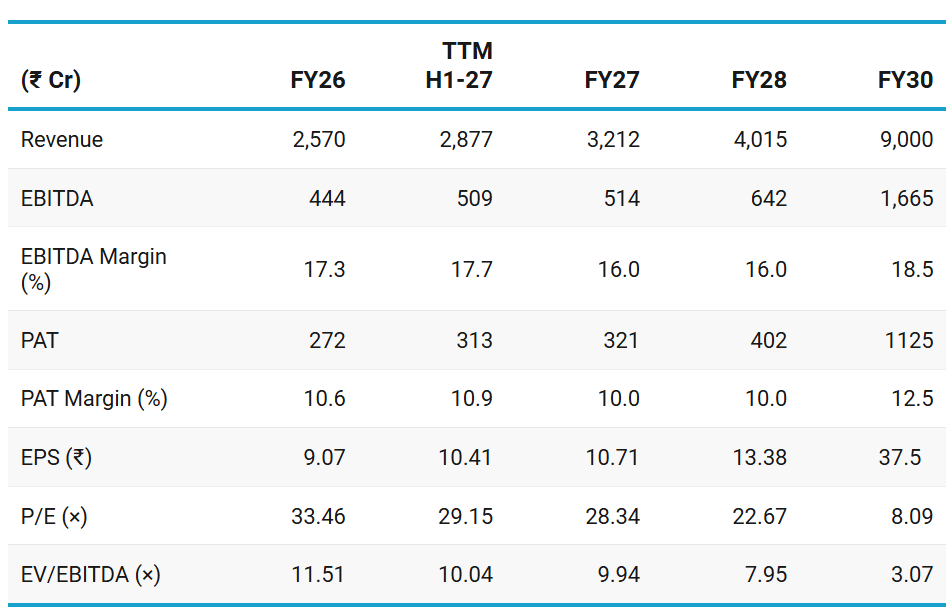
Current Market Price = ₹303.45| Market Cap = ₹4,615.5 Cr
Revenue growth of minimum 25% assumed for FY28 given the strong order-book.
At FY27, FY28 forward earnings valuations look very reasonable
FY27 guidance is already in the price
The valuations at $1 billion revenue target look very attractive but that is too far in the future
Valuations will start looking attractive from a FY29 perspective as the margin expansion from the backward integrations kick in
PAT of ₹1,000 Cr+ in FY30 at a conservative multiple of 15× could deliver a 3×+ opportunity in market cap from current levels of ₹4,615.5 Cr of market cap
8.2 Opportunity at Current Valuation
Valuations are really attractive against the long-term vision of reaching USD 1 Bn in revenue with margin expansion of 200-300 bps
The margin expansion is not yet discounted in the price
Unexecuted order book of ₹7,237 Cr (up 32% YoY) provides revenue visibility up to H1 of FY29.
Capacity is in place to support growth guidance
Macro Tailwinds (Power & Grid Super-Cycle)
Domestic Grid Expansion: India’s transformer market supported by planned transmission grid investments and a 500 GW renewable energy target by 2030.
Emerging High-Demand Segments: Accelerated loads from data centers, railway electrification, EV charging infrastructure, and green hydrogen create persistent, non-cyclical demand.
8.3 Risk at Current Valuation
Since FY27 is already in the price, the thesis depends on backward Integration delivering margin expansion
200 to 300 bps of EBITDA margin expansion depends heavily on selling component capacities (bushings, pressboard insulation, CTC conductors, tanks, CRGO) to third parties beyond captive use.
Commissioning Delays: While commercial commissioning across backward integration units is targeted for Q1 FY28, management has already factored in potential delays of up to one quarter. Stabilization lags or delay in commercial sales starting in FY28–FY29 could defer expected cost savings and top-line scaling.
While order-book provides support till H1 FY29 any weaking in the macro tailwinds will be a big setback to the entire thesis
Previous coverage of TARIL

Don’t like what you are reading? Will do better. Let us know at hi@moneymuscle.in
Don’t miss reading our Disclaimer
Peer comparison will be helpful.
Chart analysis
Support, resistance levels
Moving average