
1. NBFC — Supply Chain Financing
sgfinserve.com | NSE: SGFIN
2. FY23-26: PAT CAGR 91% & Net Inerest Income CAGR 81%
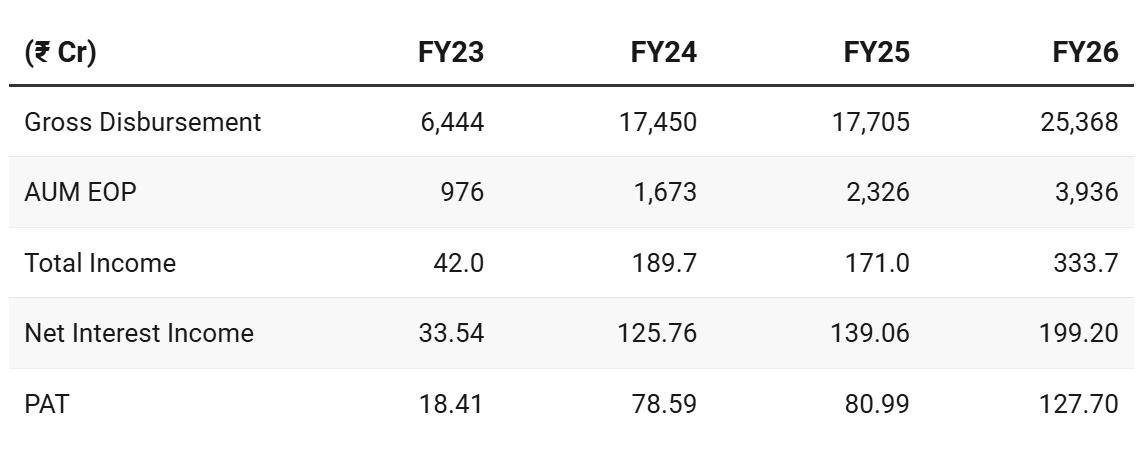
FY25: A regulatory pause lending in H1 to comply with Type II NBFC licensing norms muted growth
FY26: Leadership transition (H2) + downward revision in guidance (after Q2 results)
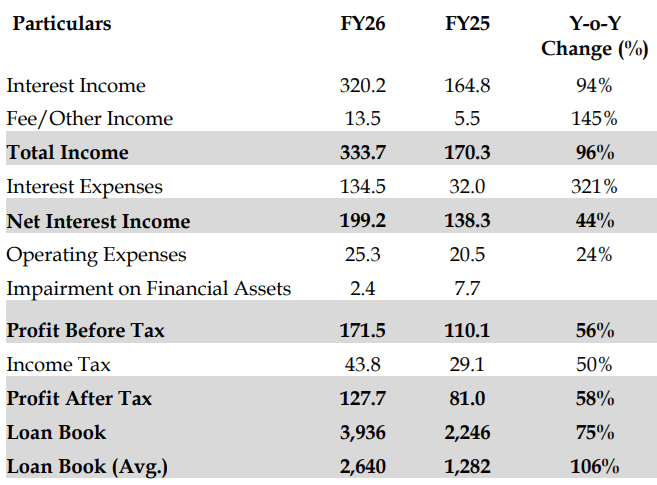
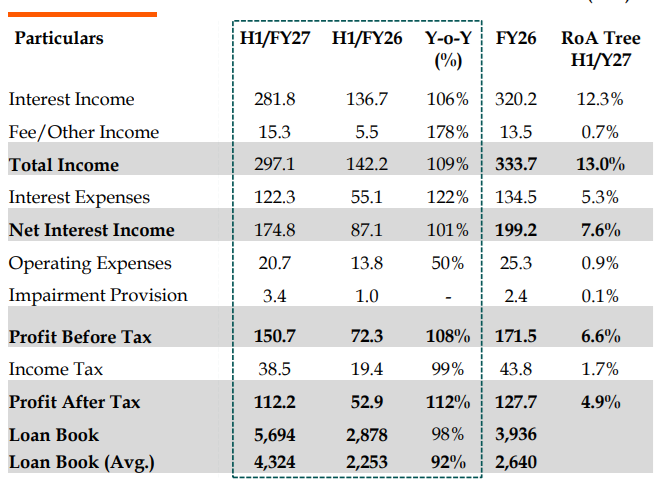
3. FY26: PAT up 58% & Net Interest Income up 44% YoY
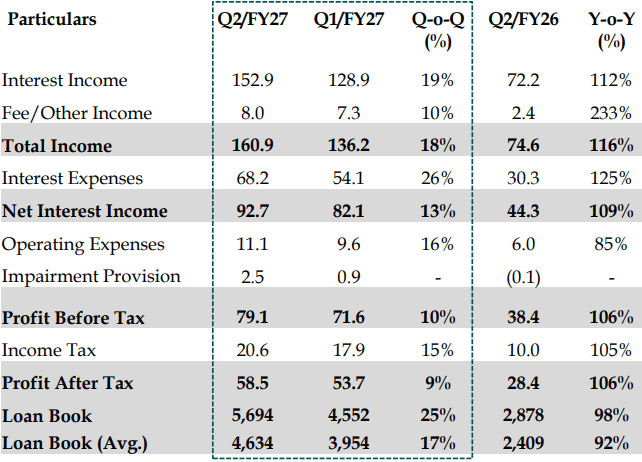
4. Q2 FY27: PAT up 106% & Net Interest Income up 109%
PAT up 9% & Net Interest Income up 13% QoQ
4. H1 FY27: PAT up 112% & Net Interest Income up 101%
6. Business Metrics: Strong Return Ratios
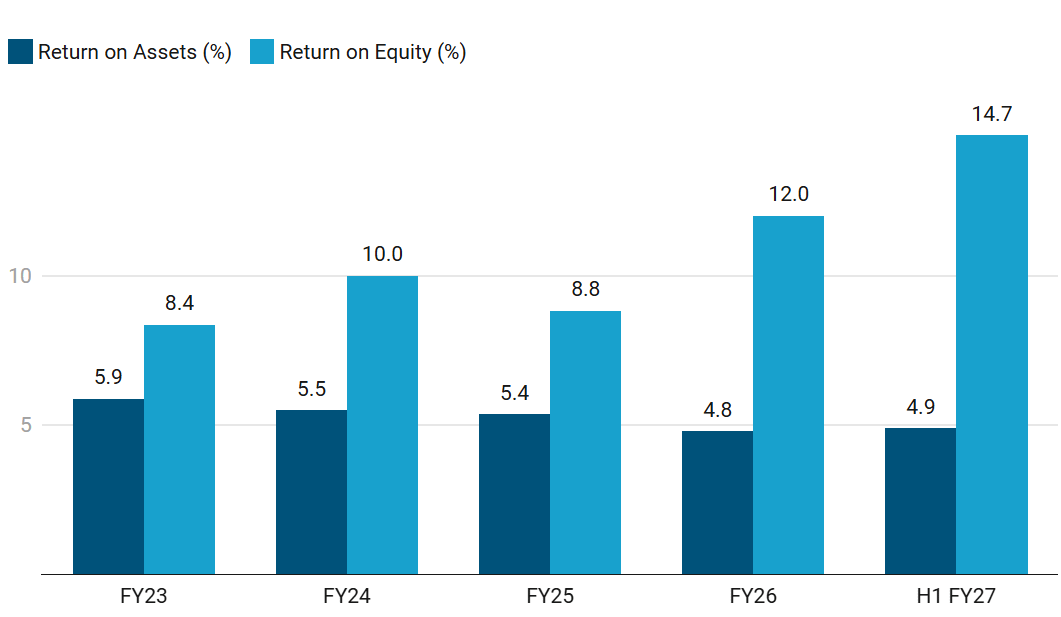
Management guidance:
ROA: 4.5%+ (sustainable)
ROE: 15% target
7. Outlook: 35% PAT CAGR
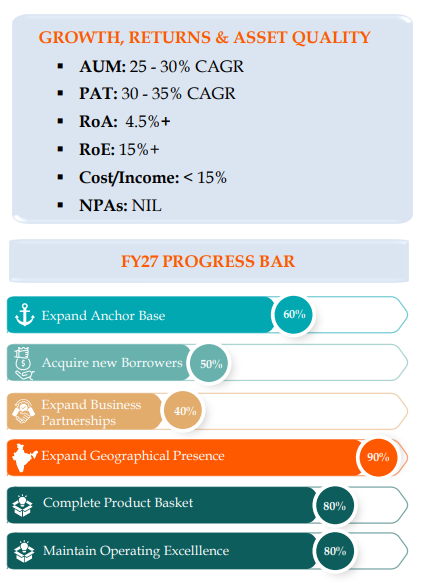
AUM Growth: 25–30% CAGR in AUM
30–35% growth run-rate over forward 12-month periods.
Driven by front-loaded growth in Q2 FY27 — loan book could reach ~₹7,000 Cr by the end of FY27
AUM of ₹10,000-11,000 Cr within the next 2 to 3 years.
PAT Growth: 30%–35% CAGR (potential for 35%–40% growth).
Full-year PAT expected exceed Q1 FY27 guidance of ₹225 Cr
Return on Assets (RoA): 4.5%+
Return on Equity (RoE): 15%+ as balance sheet leverage increases.
Cost-to-Income Ratio: Less than 15%
Asset Quality & Credit Costs: Nil NPAs through conservative, anchor-led credit underwriting.
Yield: Blended yield is expected to remain stable at around 13%
~12.5% interest yield and 50–70 bps fee income
To support accelerated business growth without immediate equity dilution — raising Debt-to-Equity cap from 3x to 4x
Asset-to-Equity ratio of up to 4x–5x
No equity dilution:
No equity raising will occur in the current financial year or until the loan book approaches ₹10,000–11,000 Cr.
At that stage, will evaluate market valuations or adjust leverage limits accordingly
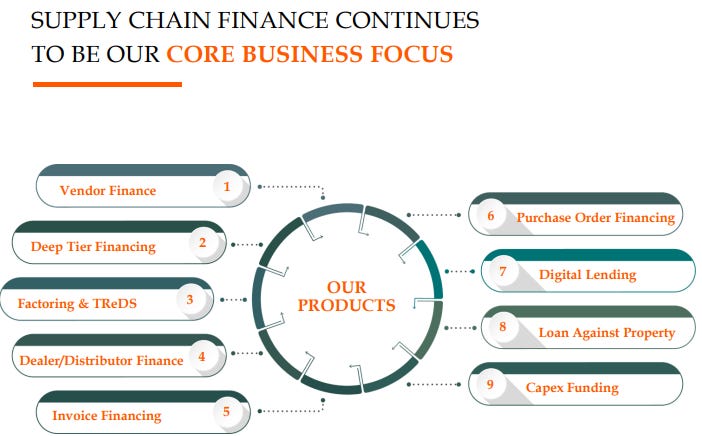
Supply chain financing will remain the core — at least two-thirds (~66–70%) of the total loan book over the next 2–3 years.
To add 2 new corporate anchors per month over the next 12–18 months
Expanding from its current base of 60 brands.
Sees room to double wallet share within existing corporate ecosystems from <5% to 10%.
New Products:
Factoring & TReDS: Scaled to ~15% of AUM as of Q2 FY27.
Digital Lending: Targeted to scale to ~10% of total AUM as the book approaches ₹10,000 Crore.
Loan Against Property (LAP) & Term Loans: Introduced to build longer-tenure assets and improve overall Asset-Liability Management (ALM) stability.
7.1 Q2 FY27 Performance vs FY27 Guidance — SG Finserve
Debt Leverage Cap Raised 2-3x in Q1 → 3-4x in Q2-27
Strong front-loaded growth — Board approved raising Debt-to-Equity cap from 3x to 4x (corresponding to an Asset-to-Equity leverage limit of up to 4x–5x).
Allows expanding loan book aggressively without requiring near-term equity dilution.
FY27 Near-Term AUM Target (₹5,500 Cr → ~₹7,000 Cr)
Q1 FY27 Guidance: Exit loan book of ₹5,500 Cr for FY27 — ₹6,000 Crore as somewhat aspirational.
Q2 FY27: Reached ₹5,694 Cr by the end of Q2 FY27
Expect loan book to reach ~₹7,000 Cr by the end of FY27.
₹10,000 Cr AUM target pulled forward (FY30 → 2–3 Years)
Q1 FY27: ₹10,000 Crore AUM was projected for FY30 (3 to 4 years away).
Q2 FY27: With the revised 4x leverage cap and higher current base — targeting ₹10,000-₹11,000 Crore in AUM within 2-3 years.
Profitability & Growth Rate Targets Refined
Full-Year PAT: Full-year FY27 PAT guidance of ₹225 Cr remains intact, with management indicating they “may end up doing slightly better than that”
Profitability CAGR:
Growth rate expectations for PAT slightly higher to 35–40% CAGR, compared to earlier 30–35% range stated in Q1
AUM growth run-rate maintained at 30%–35% CAGR.
8. Valuation Analysis — SG Finserve
8.1 Valuation Snapshot
Current Price — ₹675
Market cap — ₹4,447.9 Cr
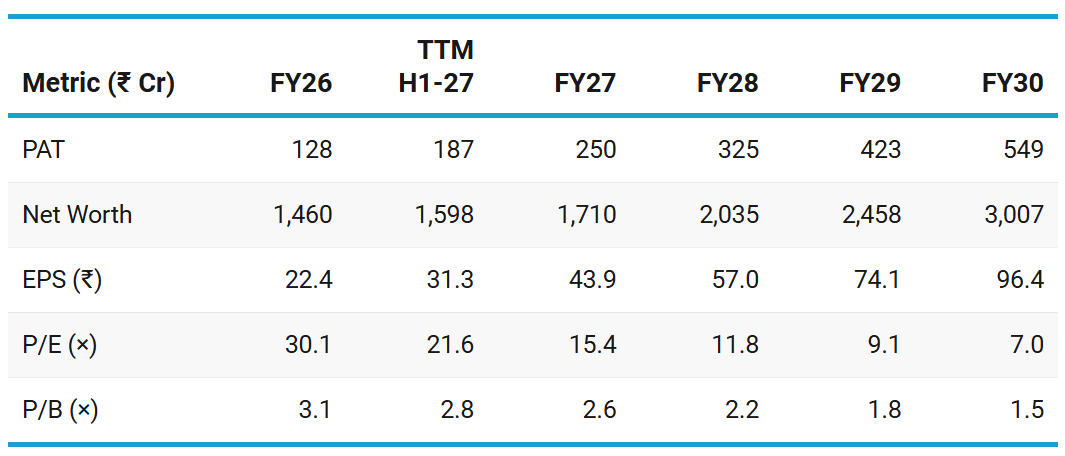
Trading at 2.78× its Q2 FY27 Book, the multiple reflects strong market premium given to SG Finserve’s return profile and asset quality
At ~15× FY27E earnings, SGFIN’s valuation is backed by a projected 30%–35% PAT CAGR.
PEG ratio of ~0.6× — earnings growth potential offers strong fundamentally-backed compounding.
Non-dilutive compounding — no equity dilution will take place loan book reaches ₹10,000–11,000 Cr over the next 2–3 years
For a stock promising 25-30% long-term AUM CAGR and 30-35% PAT CAGR over the long-term with nil NPA the forward valuations of ~2.2× P/B (FY28) provide an opportunity for re-rating of multiples closer to 3× P/B
8.2 Opportunity at Current Valuation
Strong head-room to grow
Reasonably priced at current valuation — The opportunity comes from earnings compounding, not immediate undervaluation.
FY27 earnings appear reasonably de-risked. Management has said that the current run-rate gives it clear visibility toward the FY27 target.
The company does not require an exceptional acceleration from Q1 levels to meet FY27 guidance.
Earnings growth if delivered will compress the valuation. This creates an opportunity even without a significant rerating.
This shows both the opportunity and the limitation: earnings must continue growing, and the market must retain at least a reasonable premium multiple.
Growth may be funded without additional equity dilution.
The valuation becomes attractive around FY28–FY29 earnings, but only if execution remains strong.
8.3 Risk at Current Valuation
Future performance already embedded in the price.
Trade at premium multiples for an NBFC currently generating around 15% RoE.
Earnings disappointment can cause a double impact — lower earnings estimate + lower valuation multiple.
SGFIN already discounts strong FY27 execution + FY28 expectations
The current price is therefore not supported by present earnings alone.
It depends on the successful delivery of FY27 and FY28 growth.
The risks are higher than the opportunity for new entrants in the stock
Existing holders can hold and ride the momentum.
Previous Coverage of SGFIN

Don’t like what you are reading? Will do better. Let us know at hi@moneymuscle.in
Don’t miss reading our Disclaimer
front-loaded fits what the ceo said at a broker meet last month.. existing dealers are buying less so about 60% of growth is new business, and a new anchor scales fastest in its first 90-180 days then tapers
did anchor adds keep pace this quarter?
A 112% rise in H1 PAT is strong, and the ROA guidance of 4.5% or more is the number to test. For a supply chain lender, a loan book heading to about Rs 7,000 crore by the end of FY27 is only good news if asset quality holds while it grows this fast.