

Short Answer (TL;DR)
Indian stock investors only need 6 financial ratios to make informed decisions:
ROCE – Business quality
ROE (with Debt) – Shareholder returns
Cash Flow Conversion – Profit truth check
PEG Ratio – Growth-adjusted valuation
Price-to-Book – Valuation for banks & NBFCs
Interest Coverage – Debt survival
Together, these ratios answer three questions that actually matter:
Is the business good? Is the stock reasonably priced? Will the company survive?
Everything else is noise.
Why Most Investors Get Stuck
Open any Indian stock screener—and you’ll see 100+ ratios:
Current Ratio
Quick Ratio
Asset Turnover
EV/EBITDA
Inventory Days
This leads to analysis paralysis.
As a retail investor, you don’t need 100 ratios.
You need the Vital Few—the ones that separate:
Compounders from Wealth Destroyers
In our previous guide on Cash Flow, we learned how to check if profits are real.
Now, we go one level deeper.
Part 1: Quality Ratios
Is this a good business?
Before asking “Is this stock cheap?”, ask:
“Is this business even worth owning?”
1️⃣ ROCE – Return on Capital Employed
The King of Ratios
If you track only one ratio for non-financial companies, make it ROCE.
What it asks:
For every ₹100 invested in the business (Equity + Debt), how much profit is generated?
Why it matters:
This is pure business logic.
If a company borrows at 10% but earns only 8% ROCE, it is destroying value—even if profits look fine.
Benchmarks (India):
> 20% → Excellent (moat / pricing power)
10–20% → Average
< 10% → Avoid (inefficient business)
Investor Insight:
Rising ROCE is a classic multi-bagger signal.
A move from 15% → 25% ROCE often precedes major stock rerating.
2️⃣ ROE – Return on Equity
The Shareholder’s View (with a trap)
What it asks:
For every ₹100 of shareholder money, how much profit is generated?
The Trap:
ROE can be artificially boosted using debt.
Example:
Equity: ₹10
Debt: ₹90
Profit: ₹5
ROE = 50% (looks amazing)
Reality = high bankruptcy risk
Golden Rule:
Never look at ROE alone
High ROE + Low Debt = Gold Standard
Always check Debt-to-Equity alongside ROE.
Part 2: The Truth Ratio
Are the profits real?
3️⃣ Cash Flow Conversion (CFO / EBITDA)
The Lie Detector
This is one of the most underrated ratios in Indian markets.
What it asks:
“You say you made ₹100 in profit—how much actually came into the bank?”
Why it matters (India-specific):
Sales can be booked easily
Cash collection cannot be faked easily
Benchmarks:
> 70% → Healthy, real profits
50–70% → Monitor closely
< 50% → Red flag
Hard Rule:
If EBITDA is rising but cash conversion is falling, something is wrong.
That’s how accounting problems show up before headlines.
Part 3: Valuation Ratios
Is the stock cheap or expensive?
A great business at a bad price is a bad investment.
4️⃣ PEG Ratio – Price with Growth Context
PE Ratio alone is misleading.
PE 50 isn’t expensive if growth is 40%
PE 10 isn’t cheap if profits are shrinking
PEG = PE / Earnings Growth Rate
Peter Lynch Rule:
PEG < 1 → Undervalued
PEG ≈ 1 → Fair
PEG > 2 → Expensive
Indian Reality:
In bull markets, finding PEG < 1 is rare.
For quality growth stocks, PEG < 1.5 is often reasonable.
5️⃣ Price-to-Book (P/B)
Only for Banks, NBFCs & Insurance
Important:
Do not use P/B for manufacturing or FMCG companies.
Why it works for banks:
For banks, Book Value = Cash + Loans (real assets).
Benchmarks:
P/B < 1 → Undervalued or bad asset quality
P/B 1–2.5 → Reasonable
P/B 3–4 → Premium (e.g., HDFC Bank historically)
Strategy:
When a strong bank trades near historical low P/B, it’s often an opportunity—not a risk.
Part 4: Survival Ratios
Will the company go bust?
6️⃣ Interest Coverage Ratio (ICR)
Debt Survival Check
What it asks:
How many times can the company pay interest using operating profit?
Danger Zones:
ICR < 1.5 → Critical
ICR < 1 → Borrowing to pay interest (Ponzi behaviour)
ICR > 3 → Safe
ICR > 10 → Fortress balance sheet
Rule:
Avoid companies with ICR < 1—no turnaround story is worth that risk.
Bonus: The Indian Governance Check
Promoter Share Pledging
This isn’t a ratio—but in India, it’s non-negotiable.
What it is:
Shares pledged by promoters to raise personal loans.
Rules of Thumb:
0% → Ideal
> 25% → Red flag
> 50% → Uninvestable
Risk:
If prices fall, lenders dump shares → crash
(Examples: Zee, Coffee Day)
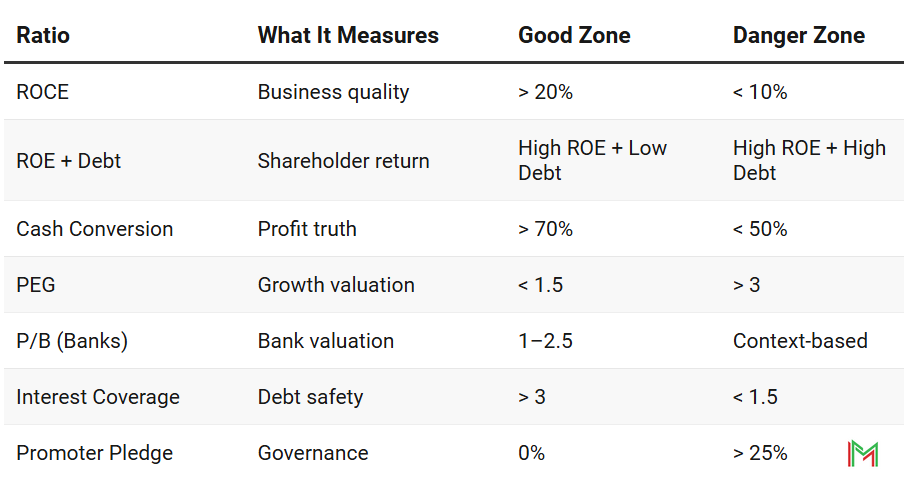
Summary Cheat Sheet
Frequently Asked Questions
Q: What is the most important financial ratio for Indian stocks?
ROCE is the most important ratio for non-financial companies because it measures true business efficiency.
Q: Is ROCE better than ROE?
Yes. ROCE includes debt and is harder to manipulate, making it a better quality indicator.
Q: Which ratio detects fake profits?
Cash Flow Conversion (CFO/EBITDA) is the best indicator of inflated profits in Indian companies.
Final Thought: Context Is King
Ratios are tools—not rules.
Power companies like NTPC will always have lower ROCE
FMCG companies like Nestlé will always trade at high PE
Use:
Cash Flow to verify truth
Ratios to judge quality, valuation, and survival
That’s how conviction is built.
Don’t like what you are reading? Will do better. Let us know at hi@moneymuscle.in
Don’t miss reading our Disclaimer