
1. Flexible packaging and solutions
uflexltd.com | NSE: UFLEX
Backward and forward-integrated ecosystem spanning upstream raw materials to downstream consumer-ready packaging:
Upstream Materials: Production of virgin and recycled PET (rPET) chips — primary raw material for packaging film manufacturing.
Packaging Films: Manufacturing BOPET, BOPP, CPP, recycled BOPET, metallized, and AlOx-coated packaging films.
Downstream Packaging Solutions: End-to-end packaging products including flexible laminates, pouches, tubes, Woven Polypropylene (WPP) bags, rice raffia bags, recycled plastic resins (rPET, rMLP), and Aseptic liquid packaging packs.
Engineering, Holography & Recycling: In-house engineering capabilities, holography, printing cylinders, and circular economy recycling plants processing post-consumer PET bottles and multi-layer plastic (rMLP) waste
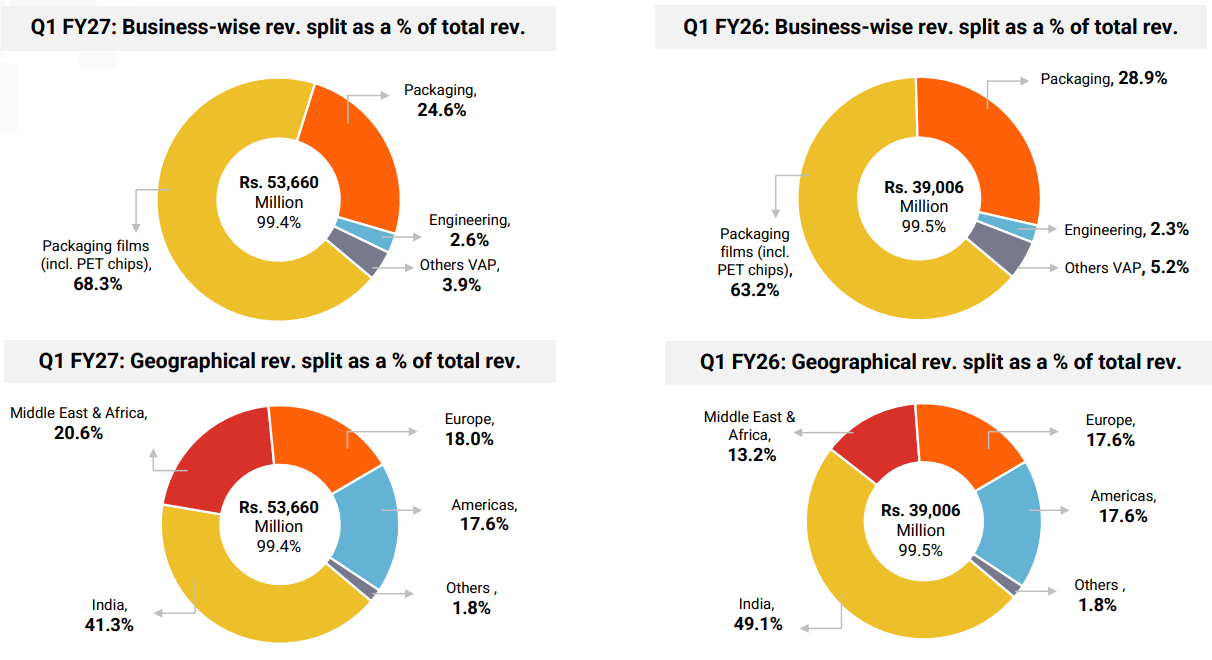
2. FY22–26: PAT CAGR -27% & Revenue CAGR 4%
A period of weak performances
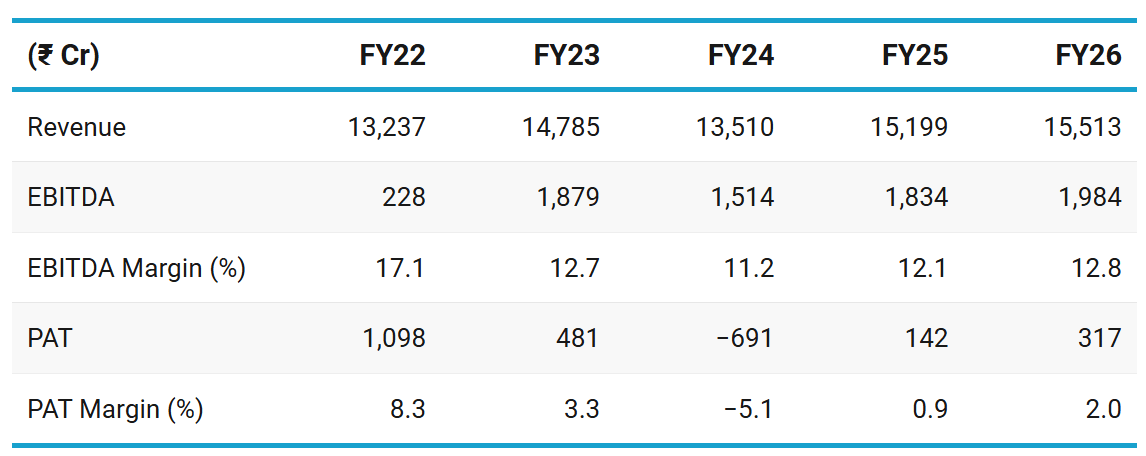
3. FY26: PAT up 123% & Revenue up 2% YoY
FY26: Year of recovery — starting of a turnaround?
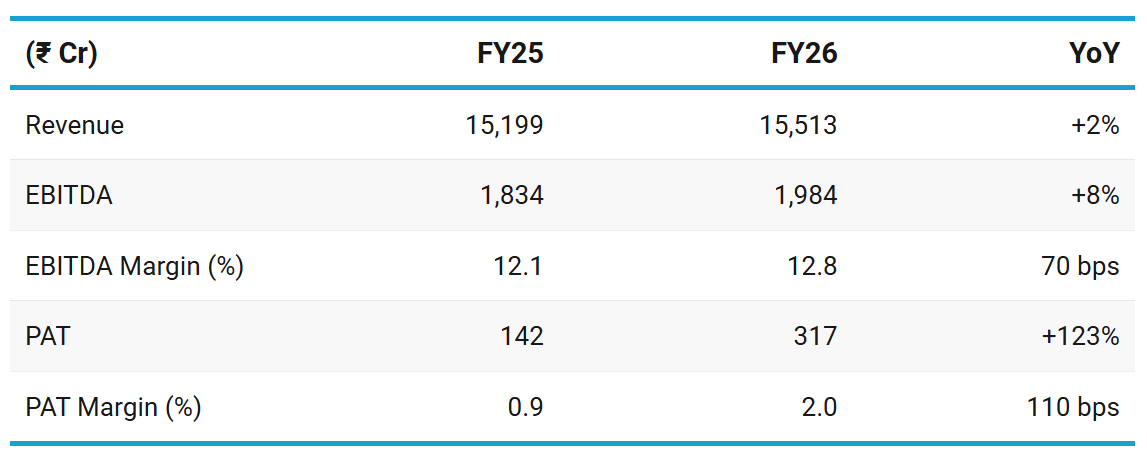
4. Q1 FY27: PAT up 630% & Revenue up 38% YoY
PAT up 116% & Revenue up 32% QoQ
Q1 PAT is higher than FY26 PAT
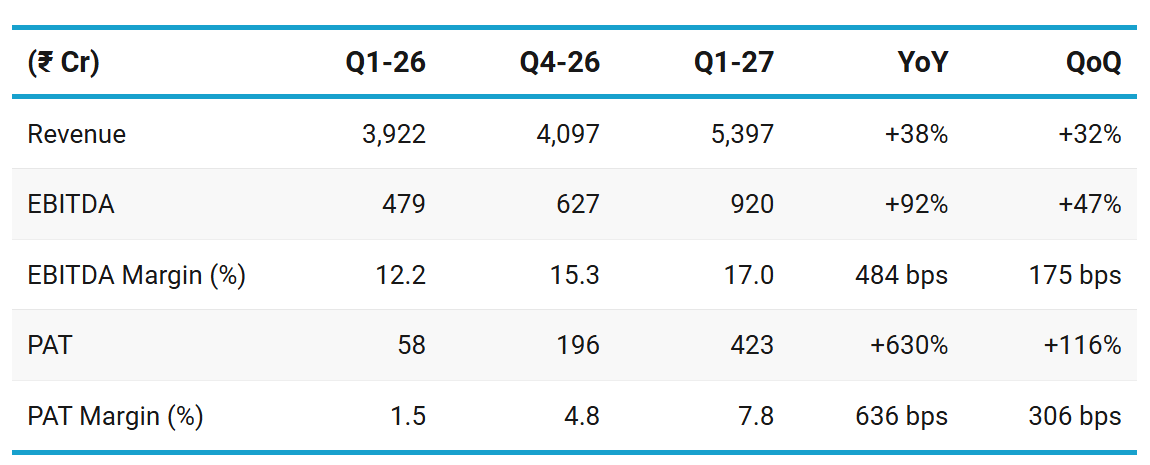
Overseas operations drive Q1 FY27 growth and profitability. Margin expansion was driven by operational leverage, stronger realizations, pass-through of higher raw material costs, currency tailwinds and localized sourcing premiums. Overseas operations, particularly in Egypt, Mexico and Nigeria, alongside our India PET chips business served as a key growth driver of our profitability.
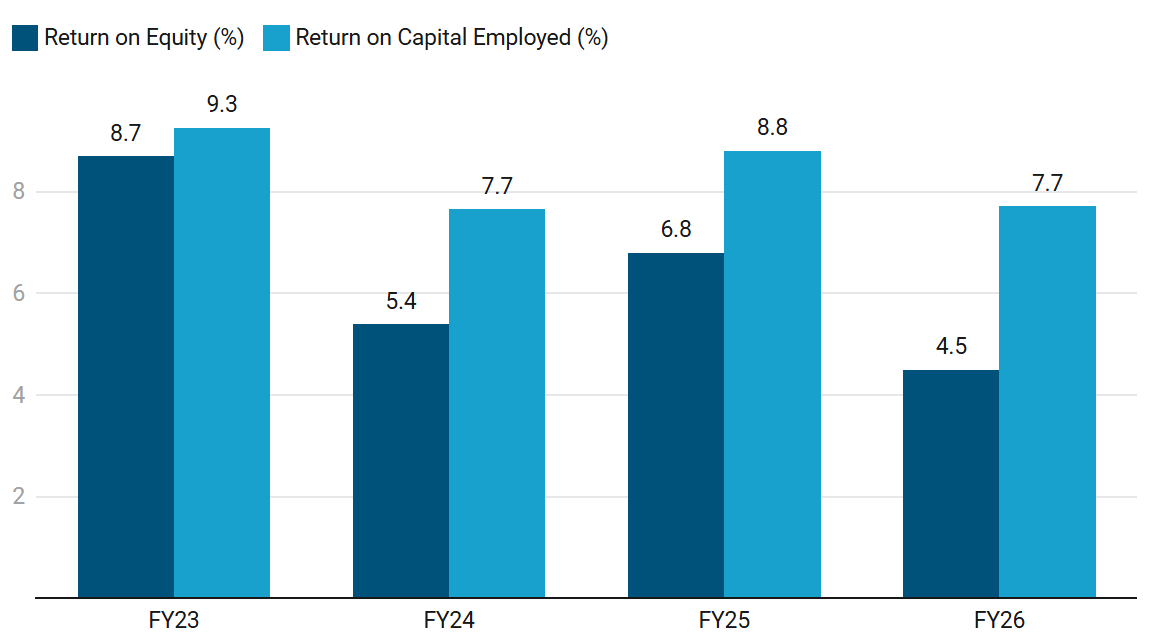
5. Business Metrics: Weak Ratios
6. Outlook: 35% Revenue Growth
6.1 Management Guidance — Uflex
The company expects to perform better in FY27 than FY26, driven by improved utilization of recently commissioned capacities, product mix optimization and additional capacities expected to come online during FY27.
FY27: we're expecting 35% growth in our top line in this financial year. And similarly, EBITDA also, we'll see the same growth coming up in this financial year as compared to last financial year.
Outlook upto FY29: you can expect a decent growth, 30% plus in coming year. And same growth will continue in FY28 also because these capex’s, what are coming on a stream, this year where 2 have come on stream, 1 is coming up in the first half. They'll have a decent capacity utilization going forward, so, they'll give a very high margin and revenue in FY28 as well as in FY29. You should look at a longterm perspective till FY29, we are seeing a visible and a very decent growth coming up because all the ingredients of growth are in place now.
7. Valuation Analysis
7.1 Valuation Snapshot — Uflex
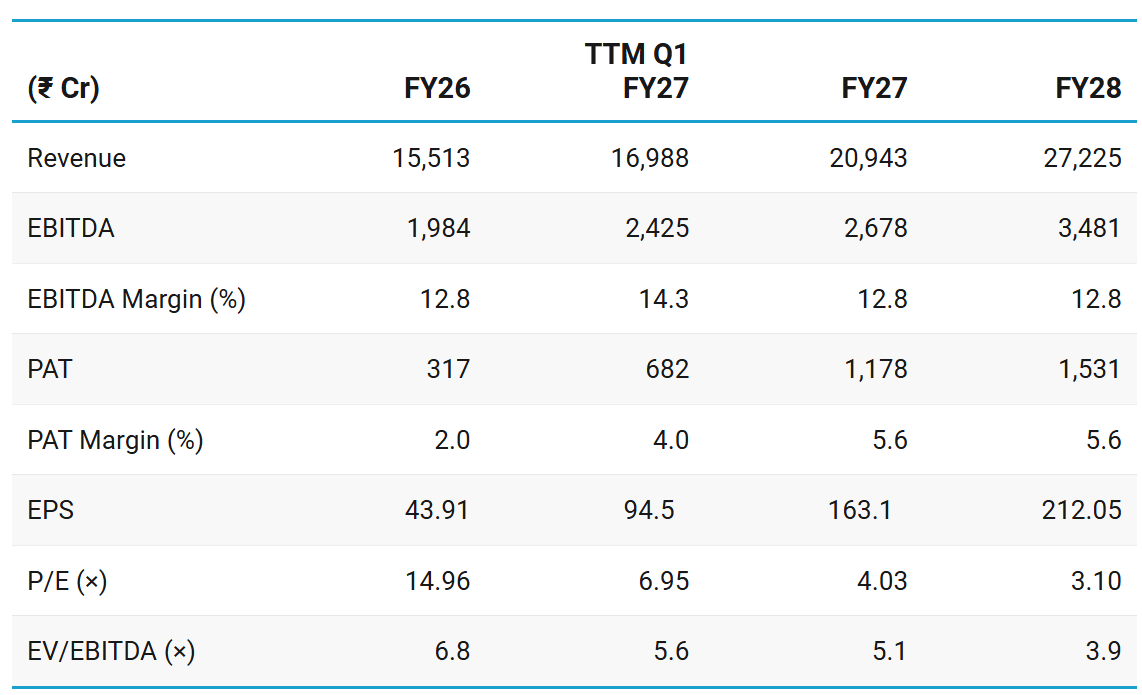
Current Market Price= ₹657; Market Cap = ₹4,744 Cr
Assumptions
FY27
35% growth in Revenue & EBITDA
Interest + Depreciation ₹1,500 Cr (Based on management estimates)
FY28 = 30% growth with stable margins
Markets are not ready to discount the current and future earnings potential given the weak track-record of FY22-26
FY27 P/E (×) of 4 and EV/EBITDA (×) of 5 indicates deep value in Uflex
Value exists at current and forward valuations
7.2 Opportunity at Current Valuation
Valuation Compression & Margin of Safety
Optically Low Multiples: Stock trades at a deep discount for a business promising 30%+ CAGR for FY27-29
FY28–FY29 Growth Compounding: As new capacities reach 60%–100% utilization by FY28–FY29, forward P/E compresses, offering substantial earnings support.
Transition from Heavy Capex to Asset Sweating
Completion of Major Capex: The peak capital expenditure cycle executed over the last 3 years is largely concluding.
Minimal Remaining Outlays: Residual capex for major projects is low relative to overall capex
Free Cash Flow Acceleration: Cash flows previously absorbed by Capital Work in Progress (CWIP) will now convert into operational cash flows as asset utilization scales up.
Structural Margin Expansion via Packaging Solutions
Capital Allocation Shift: 60-70% of incremental capex toward high-ROE, high-margin Packaging Solutions (Asepto liquid packaging, WPP bags, and PCR/rPET recycling) rather than standard commodity films.
Mix Enrichment: Revenue share from Packaging Solutions (36% in FY26) is set to expand significantly. This structural shift anchors full-year normalized EBITDA margins at 14%+.
Aseptic Scaling: The 12-billion-pack Egypt Aseptic plant expands total global Asepto capacity to 24 billion packs, ramping from 30% utilization in Year 1 (FY27) to 100% by Year 3 (FY29).
Global Footprint & Near-Customer Pricing Power
Insulation from Supply Bottlenecks:
Plants spread across India, Egypt, Mexico, USA, Poland, and Nigeria allow UFlex to follow a “75% near-to-customer” turnover policy, protecting revenues from global shipping and freight disruptions.
Localized Sourcing Premiums: Overseas customers are paying regional premiums for assured local supply, enabling UFlex to pass through raw material cost variations smoothly.
7.3 Risk at Current Valuation
Spread Moderation: Management explicitly warned that Q2 and H2 will see normalisation as film spreads cool down to guided full-year levels of 14%+.
Raw Material Volatility: Upstream feedstocks (PTA, MEG, Homo Polypropylene, Brent crude) experience high price volatility. If oversupply in commodity BOPET/BOPP films leads to aggressive price cuts in global markets, margins could compress below guided targets.
Geopolitical Vulnerability:
International plants (Egypt, Mexico, Nigeria, USA, Europe, Poland) generate 80% of incremental Q1 revenue and 60%–65% of forward growth.
Facilities in Egypt and Dubai are exposed to ongoing conflicts in West Asia, shipping bottlenecks in the Red Sea / Bab-el-Mandeb, and rising freight costs.
Foreign Exchange Exposure:
Earnings across international subsidiaries are subject to currency fluctuations (e.g., Egyptian Pound, Nigerian Naira, Euro, Mexican Peso).
Management cautioned that foreign currency gains recorded in single quarters can easily reverse in subsequent periods.
Execution & Ramp-Up Risks on Greenfield Projects
Egypt Aseptic Packaging Plant: Expanding Asepto capacity from 12 billion to 24 billion packs globally depends on the successful commercial execution of the Egypt plant.
Utilization projected at ~30% in FY27 and 60%–70% in FY28.
Delays in customer off-take, certification, or regional adoption could delay projected EBITDA contributions.
Dharwad BOPP Line: Additional capex spending (~₹700 crore) for the Dharwad facility must be absorbed smoothly by domestic market demand in FY28.
Import Dumping & Regional Competition
Domestic Indian Market Constraints: Indian FMCG/packaging market is highly price-sensitive, with lower price realisations than overseas markets.
Duty-free imports from countries like Indonesia (under trade agreements) create pricing pressure in domestic liquid packaging and film segments.
European Subdued Demand: European operations continue to face low-priced imports from Asian suppliers alongside sluggish CPG consumer spending.
Don’t like what you are reading? Will do better. Let us know at hi@moneymuscle.in
Don’t miss reading our Disclaimer