
1. 3rd Party Logistics, Enabling Digital Commerce
shadowfax.in | NSE: SHADOWFAX
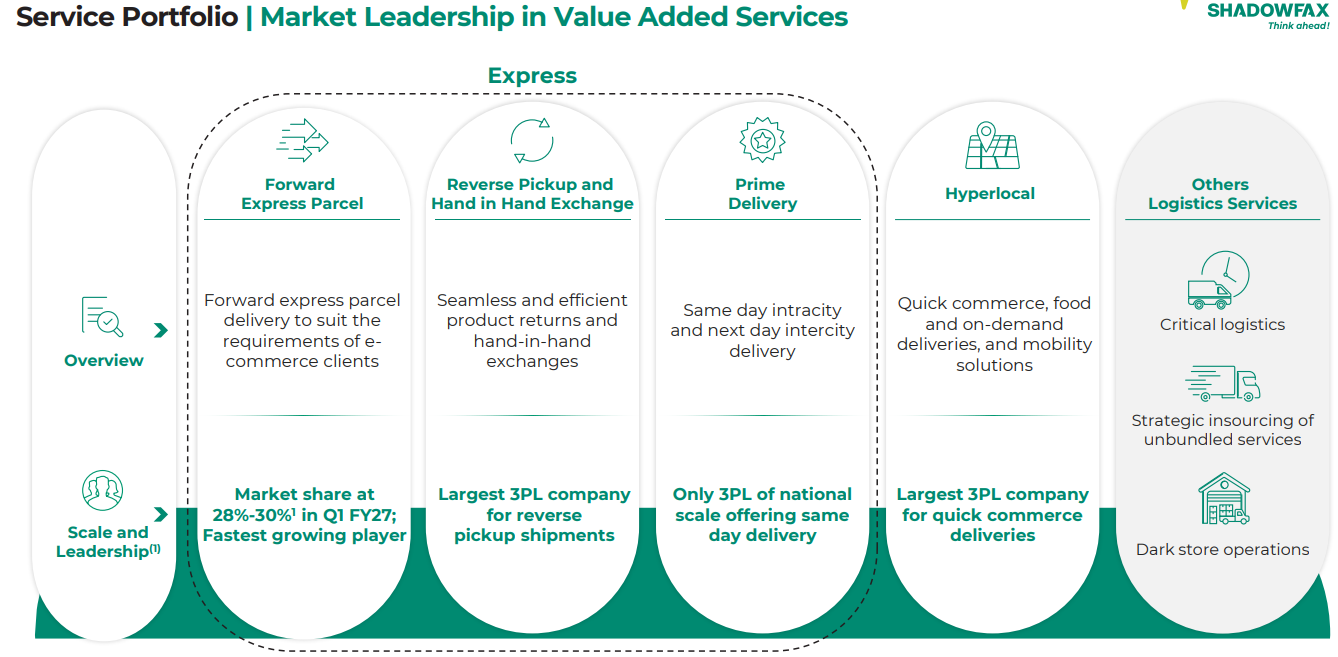
Serves a wide category of enterprise clients including horizontal and vertical ecommerce, quick commerce, food marketplace, and on-demand mobility companies,
Range of services include express forward parcel, reverse pickups and hand-in-hand exchange, quick commerce and on-demand hyperlocal deliveries
2. FY23-26: Turned profitable — Revenue CAGR of 44%
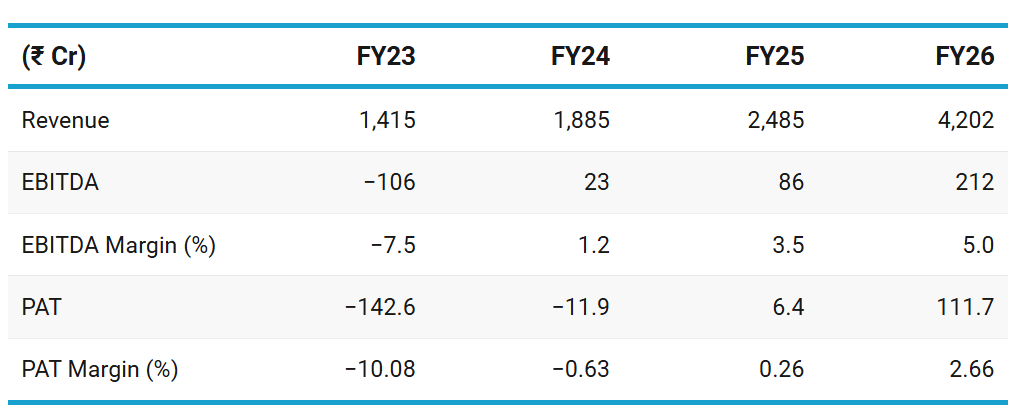
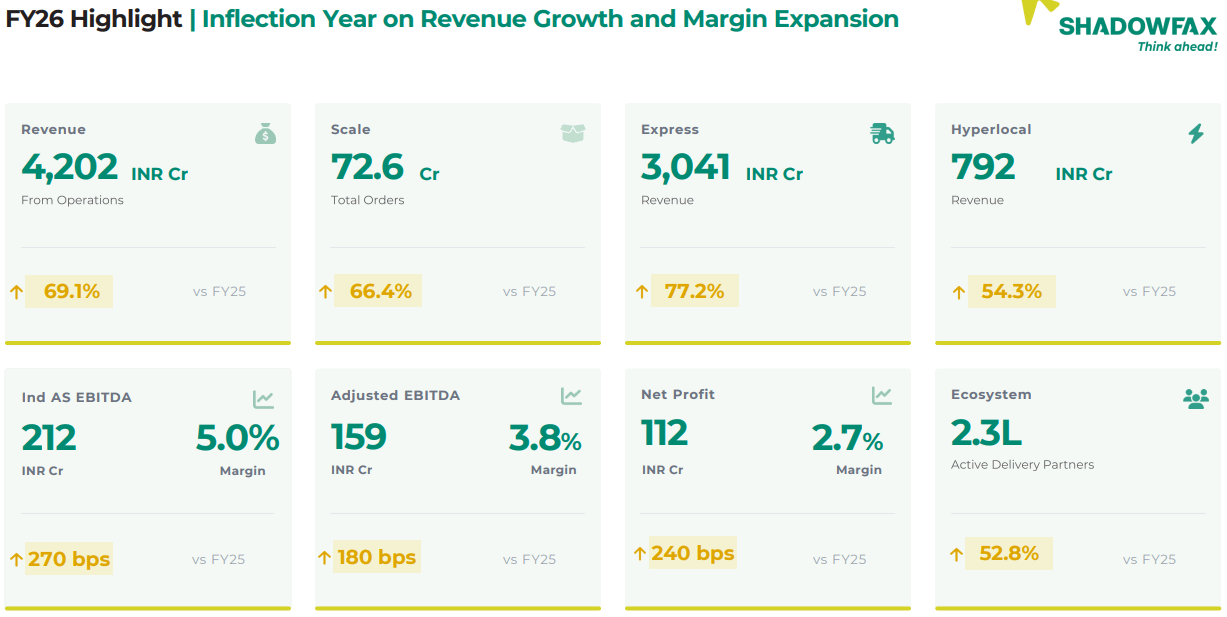
3. FY26: PAT up 1,639% & Revenue up 69% YoY
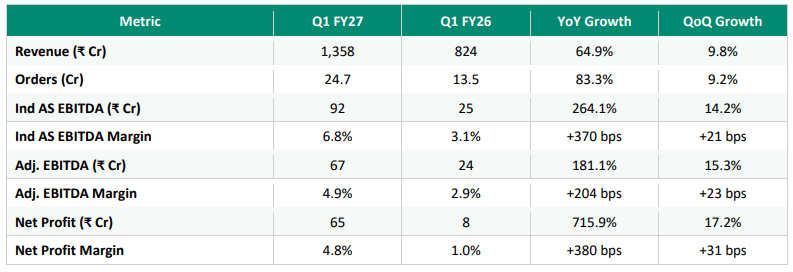
4. Q1 FY27: PAT up 716% & Revenue up 65% YoY
PAT up 17% & Revenue up 10% QoQ
This marks the fifth consecutive quarter of 60%-plus revenue growth, with growth and margins now compounding together.
5. Outlook: Growth of 38-40% & margin expansion
5.1 FY27 Guidance
Revenue Growth: Raised FY27 revenue growth to 38–40%, up from the previously guided 27–30%.
Revision driven by forward projections from large enterprise customers and aggressive acquisition in the D2C and SME segments.
Margin Expansion: Remains consistent with earlier projections of 100–150 basis points (bps) of expansion for FY27.
Intends to reinvest excess profits into the business or pass them to customers to further accelerate market share gains.
Capex Intensity: Capex front-loaded in H1 FY27 to build capacity ahead of the peak festive season.
FY27, capex to reduce to 2.5–3.5% of revenue, down from 4.4% in FY26.
Segment-Specific Targets
Prime Large: Reached FY27 target of 10,000 pin codes within Q1
Raised the FY27 target to 12,000 pin codes.
Expected to scale white goods shipments in Q2 FY27.
Quick Commerce (Dark Stores): Ahead of plan to open 100 dark stores in FY27
Network Coverage: Aims to reach 17,000 pin codes by FY27 end
On track to full national coverage by FY28.
5.2 Long-term Outlook
Revenue and Market Share Growth
Sustainable Growth Pace: At least 25-30% year-on-year.
Market Share Drivers: Growth to come from two primary sources:
underlying expansion of the 3PL market (50–55%) and aggressive market share gains (40–45%).
market share expansion in Express Parcel will continue for at least the next six to eight quarters as the industry consolidates around the two largest players.
Profitability and Margin Trajectory
Near-Term (FY27–FY28): Steady margin improvement of 100-150 basis points annually.
Moderate expansion due to investments in “build mode,” including adding physical capacity and new pin codes.
Long-Term Post-FY28: Once heavy infrastructure investments saturate, a “rapid expansion” of 200-250 bps annually.
Steady-State Goal: Long-term target of steady-state EBITDA margins in the “early teens”.
Strategic Growth Engines — four key “engines” that will drive growth:
D2C and SMEs: High-yield segments (typically 20–25% higher than enterprises) that are growing at a triple-digit year-on-year rate.
Prime Large: Expanding delivery for volumetric goods (e.g., appliances, furniture) from 6,000 pin codes to 12,000 pin codes by the end of FY27.
Quick Commerce & Dark Stores: Open 100 dark stores to anchor vertical quick commerce,
Could eventually comprise 20–25% of the total quick commerce market.
National Coverage: On track for full national coverage by FY28.
Capital Expenditure (Capex) Outlook
Long-Term Trend: To settle between 2-2.5% as the network matures
5.3 Q1 FY27 Performance vs FY27 Guidance
Q1 FY27 significantly exceeded the annual guidance
Revenue Growth: 64.9% growth vs original guidance of 27-30% growth
Upgraded the FY27 revenue growth guidance to 38–40%.
Hyperlocal: Revenue grew 53% vs projections of 45-50% gorwth.
Adjusted EBITDA margins: Expanded by ~200 bps YoY
Despite expansion in Q1 — maintaining original full-year margin expansion guidance of 100–150 bps.
6. Valuation Analysis — Shadowfax Technologies
6.1 Valuation Snapshot
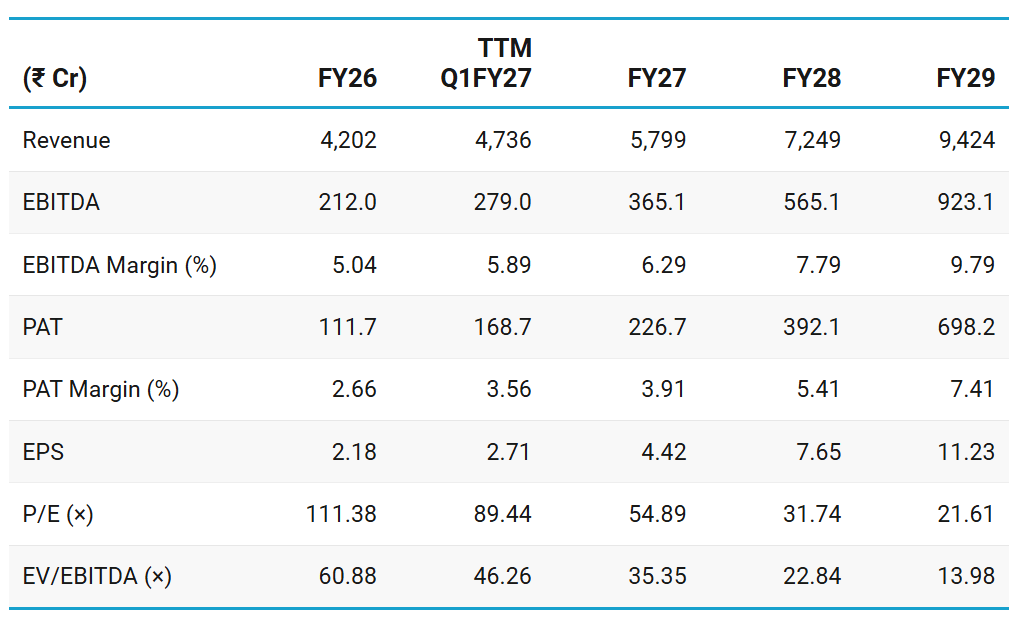
Current Market Price — ₹242.8
Market cap — ₹ 14,233.6 Cr
On TTM Q1FY27, the stock trades at: 90× P/E, 46× EV/EBITDA
That is premium valuation for a logistics company.
If you are a new entrant into the stock — Opportunity emerges over the longer term
If you already own the stock — ride the momentum as the growth guidance is delivered
6.2 Opportunities at Current Valuation
Valuation looks expensive, but opportunity if FY27/FY28/FY29 growth comes through.
Rapid Revenue Acceleration
Industry Consolidation: One of only two large 3PL networks of national scale
Expects market share expansion to continue for the next 6-8 quarters as volumes consolidate away from smaller, inefficient players.
Shift to High-Yield Segments
D2C and SME (Shadowfax 360): Growing at a triple-digit rate
Offers 15–20% (or up to 25%) higher yields compared to large enterprise contracts.
Self-serve “Shadowfax 360” platform allows for zero-touch onboarding of thousands of SMEs without increasing headcount.
Prime Large (LCV Deliveries): Addresses a large underserved market with higher per-shipment yields and high entry barriers.
Upcoming launch of white goods (appliances) in Q2 FY27 is expected to further boost realizations.
“Category Creation” in Quick Commerce
Vertical Quick Commerce: Vertical quick commerce (category-specific specialists) could grow to 20–25% of the total quick commerce market.
Dark Store Advantage: Ahead of its plan to open 100 dark stores in FY27, with 47 already live.
These stores serve as a strategic moat, allowing fashion and beauty brands to offer 30–45 minute delivery, a segment with higher value per engagement than horizontal fulfillment.
Margin Expansion and Operating Leverage
Steady-State Target: Aiming for EBITDA margins in the “early teens” once major network investments (like the OneNCR sort center) saturate and operating leverage kicks in
Strategic Acquisitions and Niche Leadership
CriticaLog: Acquisition allows Shadowfax to dominate the high-value luxury segment (jewelry, electronics),
Will grow faster than the core business over the next 12 months as cross-selling initiatives mature.
Network Reach: Shadowfax added 716 new pin codes in Q1 FY27 alone and is on track for full national coverage by FY28, which acts as a structural advantage against newer competitors.
6.3 Risks at Current Valuation
If execution slips, the opportunity disappears.
Macroeconomic and Cost Volatility
Fuel and Labor Shocks: Logistics model is highly sensitive to diesel price hikes and minimum wage increases.
Rapid rises in fuel costs can make logistics “expensive for customers” and potentially impact consumption demand.
Consumption Sensitivity: The “build mode” strategy relies on the assumption that India’s digital penetration will nearly double by FY30.
Any slowdown in underlying consumption demand could lead to underutilized infrastructure — new facilities typically take 6–8 months to reach optimal utilization.
Execution Risks in High-Yield Segments
Operational Complexity of Large Parcels: Management admitted that losses and damages were higher during the initial launch phase
Sustaining margins depends on keeping these lost shipment costs (currently 5.5%) under control.
Dark Store Model Validation: Management noted that while early results are good, it is “too early to say exactly” what the long-term ROIC will be as the model scales up.
CriticaLog Integration: The success of the “Other Logistics” segment depends on a 12-month cycle of brand and platform integration for CriticaLog.
High-value shipments have longer sales cycles and require significantly more convincing and trust-building with customers.
Strategic and Competitive Pressures
Pricing Pressure from Anchor Customers: Risk that large marketplace clients may demand better pricing as Shadowfax’s operational leverage and profitability improve.
Market Share Stabilization: Current phase of rapid market share gain will stabilize by FY28.
Post-FY28, growth is expected to align more closely with the underlying industry growth of 25%–30%,
May lead to a normalization of the high growth multiples currently assigned to the stock.
Capital Intensity and Asset Strategy
Asset-Heavy Risk: The strategy of owning “everything under the roof” (sort centers, hubs, dark stores) increases fixed costs.
Makes the company more vulnerable to margin compression if volumes do not grow at the guided pace to provide the necessary operating leverage.
Help your group stay ahead. Share now!
Don’t like what you are reading? Let us know at hi@moneymuscle.in
Don’t miss reading our Disclaimer