
1. World’s 3rd & Asia’s Largest Crane Rental Company
sanghvicranes.com | NSE: SANGHVIMOV
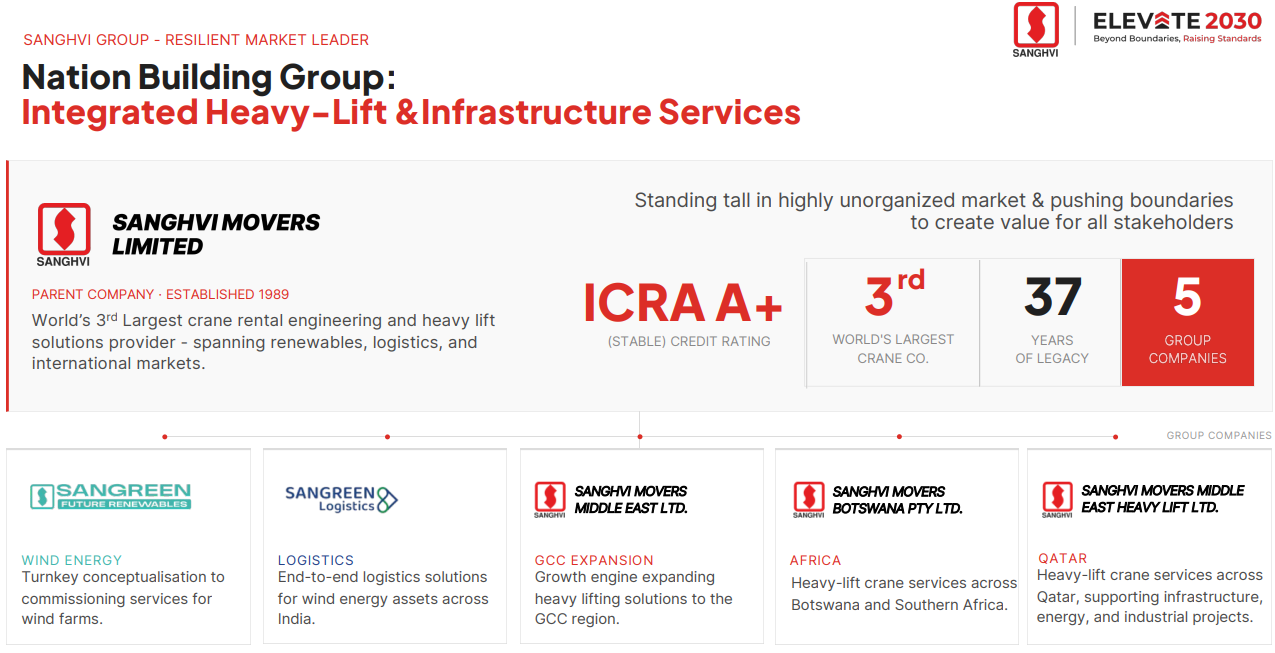
Business Segments
Crane Hiring & Ancillary Services (Core Business)
~Two-thirds of total operational revenue.
Services include heavy-lift crane rentals, equipment mobilization/demobilization, lifting plan engineering, and specialized equipment operation.
Renewable Energy E&C (Sangreen Future Renewables)
~One-third of total operational revenue.
Turnkey Engineering & Construction (E&C) for wind power projects.
Its scope ranges from concept to commissioning, including wind turbine component logistics, civil foundation prep, mechanical erection, electrical integration, and commissioning.
Project EPC & Heavy Logistics
Lifting, rigging, and specialized surface transport logistics across major construction and project sites (Sangreen Logistics)
Expanded beyond India into Saudi Arabia, Qatar, and Botswana
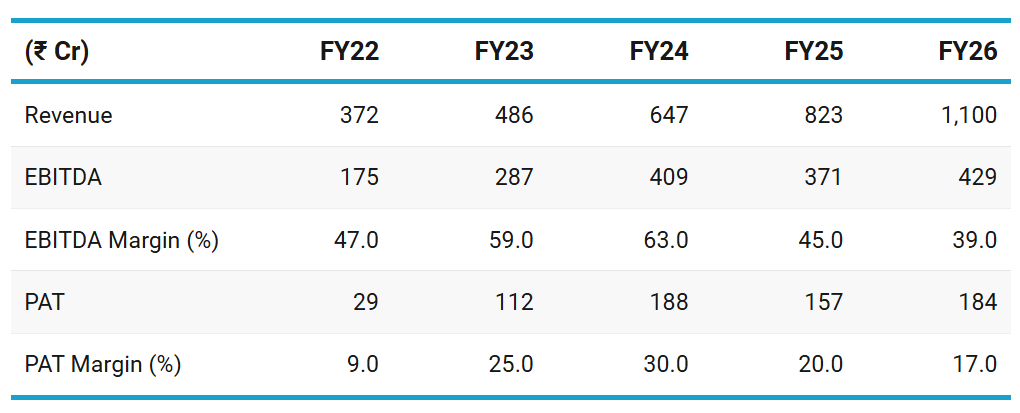
2. FY22–26: PAT CAGR 59% & Revenue CAGR 31%
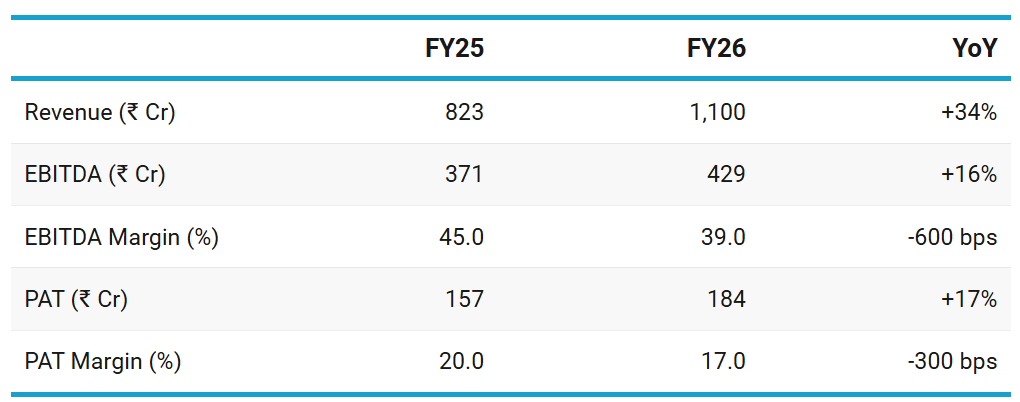
3. FY26: PAT up 17% & Revenue up 34% YoY
4. Q1 FY27: PAT up 30% & Revenue up 40% YoY
PAT down 5% & Revenue up 9% QoQ
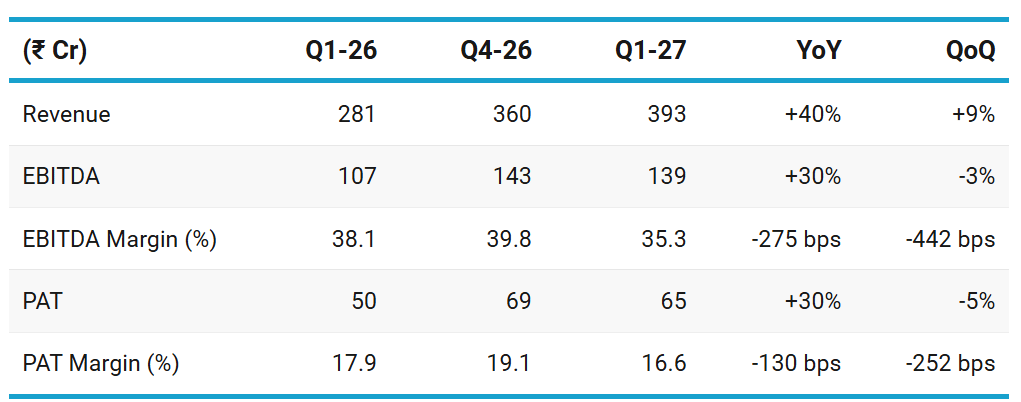
Contraction in EBITDA margins both sequentially and year-on-year
Driver of the contraction was in the core crane rental business
Expected Credit Loss (ECL) Provisions:
Driven by statistical aging of trade receivables in India.
Management expects this to rationalize over the course of FY27 as collections improve.
Revenue Mix & Cross-Rentals:
Incremental client demand was fulfilled by hiring ancillary equipment and cross-renting cranes from third parties rather than deploying fresh CapEx.
While dilutive to margins, cross-renting requires zero capital investment, making it accretive to cash flow and Return on Capital Employed (ROCE).
One-Time Employee Performance Incentive:
One-off reward paid to frontline operators and senior executives to commemorate surpassing the ₹1,000 crore annual revenue in FY26
Margin contraction was also influenced by the growing share of the Renewables E&C segment (Sangreen Future Renewables):
In Q1 FY27 it accounted for 37% of revenue vs 31% in Q1 FY26 due to project execution phasing.
Renewables E&C is an asset-light, high-ROCE business operating at segment EBITDA margins of 14%–18%.
As this lower-margin, capital-light segment increases its share in the revenue mix, it optically dilutes the group’s blended EBITDA margin while generating incremental absolute EBITDA without straining the balance sheet.
5. Business Metrics: Average Return Ratios
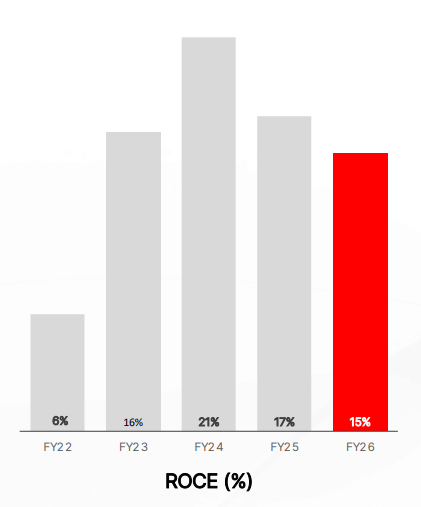
Despite strong revenue growth, ROCE has actually declined from FY24 levels as the SANGHVIMOV invested heavily in new cranes
Management is guiding for marginal improvement in ROCE :
FY27: 16.25–16.5% → FY28 16.5–17%
6. Outlook: 30% Revenue CAGR for FY26-28
6.1 Management Guidance — Sanghvi Movers
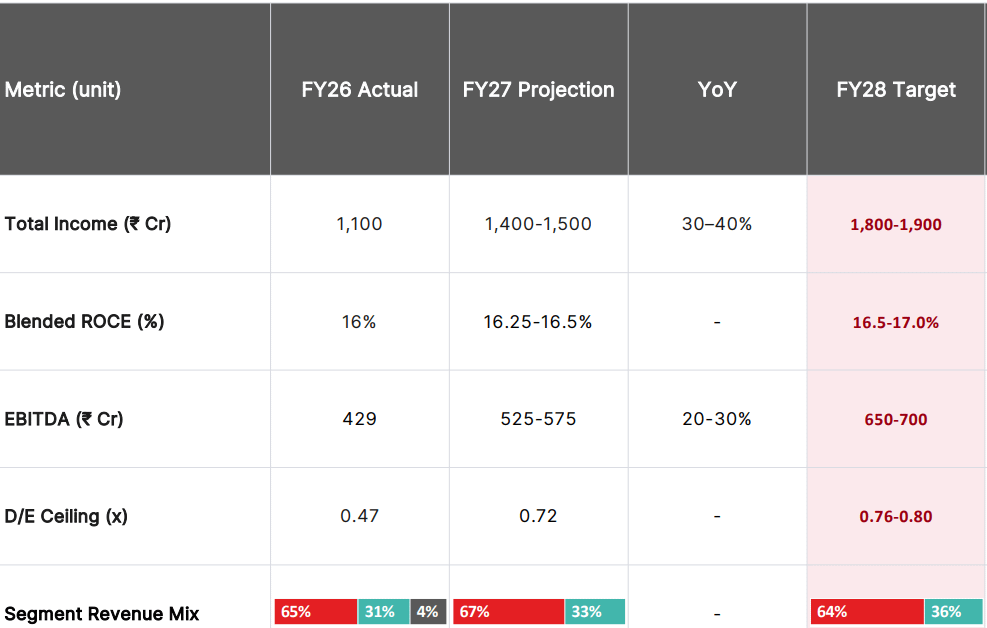
Promising 30%+ revenue CAGR as FY28 revenue grows to ₹1,800-1,900 Cr from ₹1,100 Cr in FY26
We have a secured order book as I mentioned of almost Rs. 1,250 crores, which is fully executable within this financial year, providing strong revenue visibility
Order book increased 19% to ₹1,253 Cr as on 24 Jul'26 from ₹1,053 Cr on 14 May’26
The ₹1,250 Cr order book to be executed in remaining three quarters of FY27 and the Q1-27 revenue of ~₹390 Cr, implies a run rate of ₹1,600 Cr+ (1250+390).
As of Q1 end Sanghvi Movers is running ahead of its revenue guidance of ₹1400-1500 Cr
7. Valuation Analysis
7.1 Valuation Snapshot — Sanghvi Movers
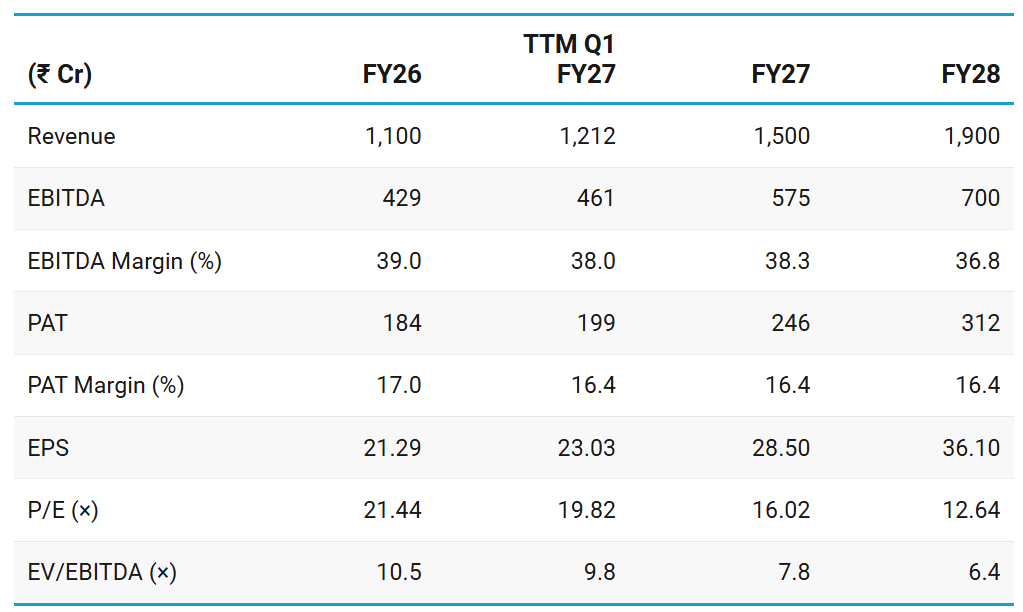
Current Market Price= ₹456.4; Market Cap = ₹3,947.9 Cr
Sanghvi Movers looks reasonable valued at current valuations with TTM Q1 FY27 P/E (×) of 20 and EV/EBITDA (×) of 10
The valuation deserves some premium as contribution of E&C is increasing
E&C can generate incremental EBITDA without substantial fixed-capital deployment, while also creating demand for Sanghvi’s cranes
The lower margin of the E&C business when compared to crane rentals should be seen in the context of lower capital requirements if the E&C business
However, overall business remains capital intensive
Crane rental business needs lots of capital to buy new cranes for them to be rented out to customers
Part of FY27/FY28 comes from increasing the capital by buying new cranes rather than extraordinary organic operating leverage.
For a company delivering 30% revenue CAGR for FY26-28, the forward valuations present an opportunity with FY28 P/E (×) of 12.6 and EV/EBITDA (×) of 6.4
SANGHVIMOV does not need a large re-rating for decent returns if FY27/FY28 guidance is achieved. A re-rating would require evidence that international expansion and renewables are structurally improving returns rather than merely increasing revenue.
7.2 Opportunity at Current Valuation
Strong outlook for growth till FY28 based on guidance with a possibility to beat guidance for FY27
Revenue visibility is strong as the order-book of ~₹1,250 crore has to be executed within FY27
Saudi Arabia can improve overall margins of the crane rental business.
In Q1, utilization was about 86% in both India/Botswana and GCC, but yield was 2.29% versus 4.10%
If Sanghvi can deploy more cranes into markets where utilization remains high but yields are substantially better, earnings can grow faster than simply adding cranes in India.
E&C business (Sangreen) can alter the quality of growth.
Core crane business produces high EBITDA margins but consumes significant capital.
Sangreen’s business operates at lower margins but is asset-light.
It as a high-ROCE business that can scale largely through working capital rather than heavy fixed-capital investment.
If renewables become a larger contributor without depressing group returns, the market may view Sanghvi as more than a pure equipment-rental company.
7.3 Risk at Current Valuation
Large capex can dilute returns if utilization or yields disappoint.
Sanghvi has approved ₹652 crore of FY27 capex, with ₹92 crore capitalised in Q1 and roughly ₹560 crore still to be deployed.
If new cranes are deployed slowly, projects are delayed, or rental yields weaken valuations will become expensive.
ROCE is not exceptional.
Management is guiding to roughly 16.25–16.5% ROCE in FY27
It is respectable, but it does not justify treating Sanghvi like a capital-light compounder. If the business keeps reinvesting heavily while ROCE remains near the mid-teens, earnings can grow without creating equally strong shareholder value.
Q1 gross debt-to-equity was about 0.54×, against FY27 guidance of 0.72×
Higher debt increases sensitivity to project delays, utilization weakness and interest costs.
EBITDA margin will decline as contribution of E&C increases
Markets may not value the company on declining margins without fully distinguishing business mix effects
Don’t like what you are reading? Will do better. Let us know at hi@moneymuscle.in
Don’t miss reading our Disclaimer